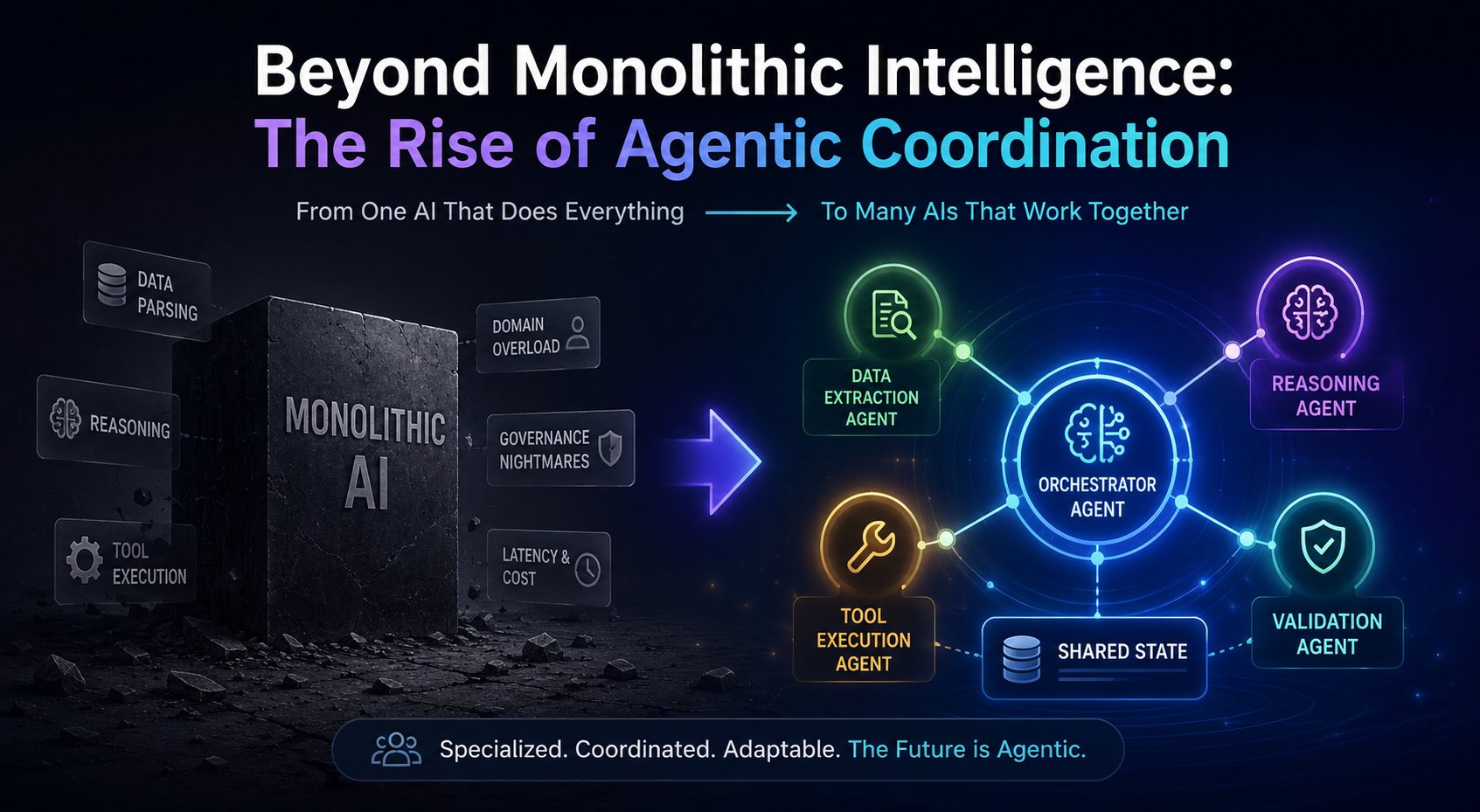
Your monolithic LLM implementation is hitting a ceiling.
It won’t fail because the model lacks “intelligence.” It won’t fail because GPT-4 or Claude ran out of parameters. It will fail because you tried to force a single, massive brain to handle a thousand different specialized contexts, and now your production environment is drowning in domain overload, governance nightmares, and unmanageable latency.
We have spent the last two years obsessed with model capability. We treat LLMs like all-knowing entities that can solve any problem if we just prompt them correctly. That approach is reaching its limit. The real bottleneck has shifted from raw model intelligence to orchestration complexity.
The industry is moving away from “one-size-fits-all” monolithic models toward a modular, specialized ecosystem of agents. We are transitioning from building one AI that does everything to building specialized AIs that collaborate. This is the era of agentic coordination.
The Death of the Monolith
In traditional software engineering, we moved from monoliths to microservices because scaling became impossible. In AI, we are seeing a similar pattern.
A single-agent system—one giant prompt loop trying to handle everything from data parsing to strategic reasoning—is inherently fragile. As you add more complexity, the risk of errors increases; one wrong step in a long chain of thought can poison the entire execution context.
Why Monolithic AI Fails at Scale
When you try to scale a single-agent system, you run into three primary challenges:
- Domain Overload: The model’s context window becomes cluttered with unrelated instructions and data.
- Governance Complexity: It is difficult to apply granular permissions or “bounded authority” to a single monolithic prompt.
- Performance Bottlenecks: A single reasoning loop for a complex task can be significantly slower and more expensive than a coordinated sequence of specialized, lightweight calls.
The Architectural Shift: Rather than focusing solely on making models “smarter,” the industry is shifting toward engineering robust agentic middleware—the glue that manages state and prevents chaos. We should treat LLMs not as singular brains, but as volatile, unreliable microservices within a distributed system.
The Jazz Ensemble Model of Multi-Agent Systems
Stop thinking about AI as a single brain. Start thinking about it as a Jazz Ensemble.
A monolithic AI is like a solo pianist playing a complex piece; it can do everything, but it lacks variety and scale. Multi-agent orchestration is different. You don’t need one person to play every instrument perfectly; you need specialized musicians (agents) who know their specific roles (instruments), follow a common key/tempo (shared state/protocols), and improvise within the structure (autonomy).
The success of the performance depends not on how “smart” one musician is, but on how well they listen to and coordinate with each other.
graph TD
    User[User Request] --> Orchestrator{Orchestrator Agent}
    Orchestrator --> AgentA[Specialized Agent: Data Extraction]
    Orchestrator --> AgentB[Specialized Agent: Logic/Reasoning]
    Orchestrator --> AgentC[Specialized Agent: Tool/API Execution]
    AgentA --> SharedState[(Shared State Management)]
    AgentB --> SharedState
    AgentC --> SharedState
    SharedState --> Orchestrator
    Orchestrator --> FinalOutput[Validated Result]
Engineering the Shift: From Automation to Autonomy
There is a technical distinction between automation and autonomy.
Automation is a rigid, linear chain of events. If step A fails, step B doesn’t happen. It’s essentially a script with an LLM inside it.
Autonomy—true agentic workflows—involves agents that operate with bounded authority and real-time context. They can perceive a failure, decide to try a different tool, or loop back to a previous state to correct an error.
Enterprise leaders like PwC and IBM are shifting toward coordinated, human-supervised orchestration at scale. They are moving from isolated agents to systems where agents collaborate through defined roles and protocols.
The Architectural Requirements for Agentic Coordination
If you are building for production, you must prioritize these three pillars:
- Defined Protocols: Agents must speak a common language (often structured JSON) so that one agent’s output is predictably usable by the next.
- Shared State Management: You need a centralized “truth” where all agents can read and write context without polluting each other’s reasoning loops.
- Human-in-the-Loop (HITL): In enterprise settings, supervision isn’t an afterthought; it is a core architectural component. You design hooks for human intervention at critical decision nodes.
How to Implement: A Modular Agent Pattern
Don’t build one giant prompt. Build a registry of specialized workers. Here is a conceptual implementation using a modular approach.
Step 1: Define the Specialized Worker
Instead of one “Master Agent,” create discrete functions that wrap specialized prompts.
Step 2: Implement the Orchestrator
The orchestrator manages the flow and, crucially, the Shared State.
Complete Working Example (Historical Example — written for illustration)
# Historical Example — written for illustration
# This demonstrates a basic modular orchestration pattern
# rather than a monolithic single-prompt approach.

class AgenticSystem:
 def __init__(self):
 self.shared_state = {"context": {}, "errors": []}
 self.agents = {
 "extractor": self.extractor_agent,
 "analyst": self.analyst_agent
 }

 def extractor_agent(self, task):
 """Specialized agent for data parsing."""
 print("[System] Running Extractor Agent...")
 # Simulate LLM call for extraction
 extracted_data = {"user_id": 123, "action": "purchase"}
 self.shared_state["context"].update(extracted_data)
 return True

 def analyst_agent(self, task):
 """Specialized agent for reasoning."""
 print("[System] Running Analyst Agent...")
 # Accesses shared state instead of receiving everything in a prompt
 user_id = self.shared_state["context"].get("user_id")
 if user_id:
 self.shared_state["analysis"] = "Valid transaction"
 return True
 else:
 self.shared_state["errors"].append("Missing User ID")
 return False

 def orchestrate(self, task):
 """The central coordination logic."""
 # Step 1: Extraction
 if not self.agents["extractor"](task):
 return "Extraction Failed"

 # Step 2: Analysis
 if not self.agents["analyst"](task):
 return f"Analysis Failed: {self.shared_state['errors']}"

 return f"Success: {self.shared_state['analysis']}"

# Execution
system = AgenticSystem()
result = system.orchestrate("Process transaction for user 123")
print(f"Final Result: {result}")
The New Frontier: AgentOps
As we move toward these multi-agent systems, the traditional DevOps stack must evolve. We are entering the era of AgentOps.
In a monolithic world, you monitor latency and error rates. In an agentic world, you have to monitor inter-agent communication overhead and coordination efficiency. You need to detect when agents enter infinite loops or when they begin “hallucination cascades” where Agent A passes a hallucinated fact to Agent B, which then amplifies it.
The scalability of your AI won’t be determined by how many billions of parameters your model has, but by how robust your coordination layer is.
Discussion
- How do we mathematically define and measure “coordination efficiency” in a production environment without incurring massive observability overhead?
- As we move toward decentralized swarm-like architectures, how do we implement enterprise-grade governance and “bounded authority” for autonomous agents?
- What are the specific latency penalties you’ve observed when moving from a single LLM call to a multi-agent reasoning chain in your own production pipelines?