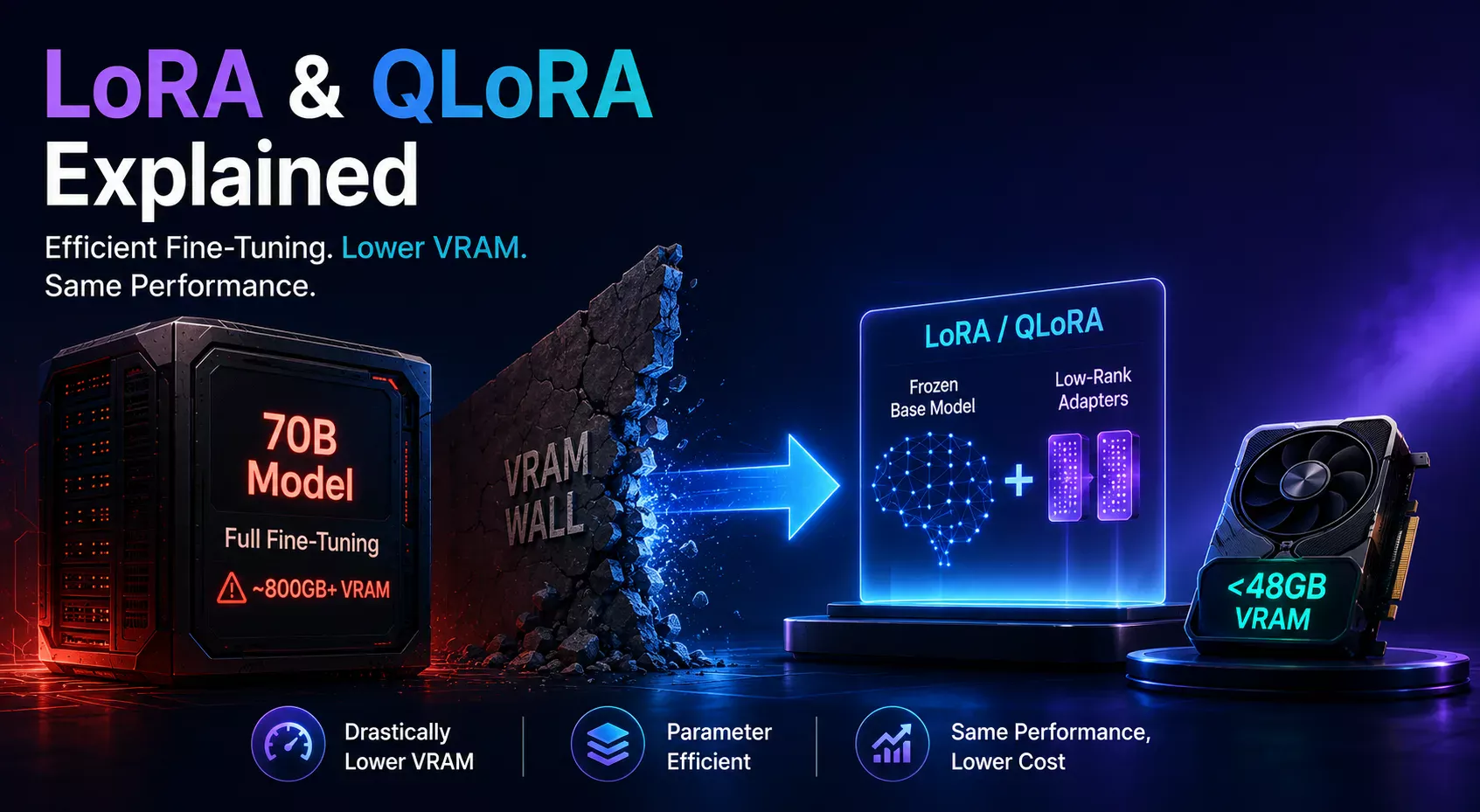
You want to fine-tune a 70B parameter model. You check your cluster requirements and realize you need nearly 800GB of VRAM. That’s not just a budget problem; that’s a “we don’t have enough hardware” problem. Most engineers think they are stuck with either the astronomical cost of full fine-tuning or the suboptimal performance of basic lightweight adapters. They are wrong.
The gap between massive, monolithic weight updates and efficient adaptation has been bridged by two specific techniques: LoRA and QLoRA. We aren’t just talking about “saving a few bucks” here. We are talking about a fundamental shift in how we approach model adaptation.
The Problem: The VRAM Wall
Standard full fine-tuning is a resource hog. When you update every single parameter in a Large Language Model (LLM), you aren’t just storing the weights. You are storing the gradients, the optimizer states, and the activations for every step of the backward pass. For a 65B model, this scales aggressively.
The math is brutal. If you try to run full fine-tuning on a massive model, your VRAM requirements scale linearly with the number of parameters. You hit a wall where even high-end clusters struggle to keep up with the sheer overhead of the optimizer states.
LoRA: The Architectural Shift
LoRA (Low-Rank Adaptation) is a Parameter-Efficient Fine-Tuning (PEFT) technique that stops trying to rebuild the engine while the car is driving. Instead, it freezes the base LLM weights entirely. You don’t touch them. Not even a little bit.
Instead of updating the massive weight matrices (W), LoRA injects trainable low-rank matrices into the transformer layers. We represent the update as the product of two smaller matrices, A and B, with a specific rank r.
The Mental Model: Full fine-tuning is like rebuilding the entire foundation, plumbing, and electrical system of a skyscraper. LoRA is like keeping the building exactly as it is but sending in a team of interior designers to change the furniture and wall colors. You aren’t changing how the building stands; you are just changing how people experience the space inside.
By training only these small “adapters,” we can achieve competitive performance in tasks like text classification, summarization, and question answering while training only 0.2-0.3% of the total parameters.
The Mechanics of Low-Rank Adaptation
graph TD
    A[Frozen Pre-trained Weights W] --> B{Forward Pass}
    C[Trainable LoRA Adapters A & B] --> B
    B --> D[Output Y = Wx + BAx]
    D --> E[Loss Calculation]
    E --> F[Backpropagate Gradients ONLY to A and B]
    F --> C
This architecture means that during inference, you can actually merge these low-rank matrices back into the base weights, resulting in zero latency overhead. Or, more importantly for production: you can keep one frozen 70B model in memory and swap out tiny adapter modules for different users or tasks. That is multi-tenant architecture done right.
QLoRA: Breaking the Memory Barrier
If LoRA solves the parameter count problem, QLoRA (Quantized Low-Rank Adaptation) solves the memory capacity problem.
QLoRA backpropagates gradients through a frozen, 4-bit quantized pretrained language model into those same Low Rank Adapters. This is where the real magic happens. By compressing the base model weights down to 4 bits, we drastically reduce the VRAM floor.
The numbers are staggering:
| Model Size | Full Fine-Tuning (Approx VRAM) | QLoRA Fine-Tuning (VRAM) | Reduction Factor |
| :— | :— | :— | :— |
| 65B Parameters | >780 GB | <48 GB | ~16x |
This isn’t just a marginal improvement. QLoRA enables you to fine-tune a 70B parameter model on a single 48GB GPU. This democratizes the entire field. You no longer need an enterprise-grade cluster; a single high-end consumer GPU or an A100 can handle the job.
QLoRA vs. LoRA: The Technical Breakdown
Don’t confuse these two. They are not “versions” of each other; they are additive strategies.
- LoRA focuses on reducing the number of trainable parameters.
- QLoRA focuses on reducing the memory footprint of the base model.
When you combine them, you get the ultimate efficiency stack: a heavily quantized base model (saving memory) paired with tiny, high-precision adapters (preserving performance).
Performance vs. Throughput Trade-offs
I’ll be direct here: there is no free lunch. While QLoRA preserves full 16-bit fine-tuning task performance, it isn’t “free.” Managing quantized weights and adapter computations can impact training throughput.
If you are looking for pure training speed (how fast can I finish an epoch?), full 16-bit training on a massive cluster will still beat QLoRA. But if you are looking at accessibility—the ability to actually run the job without spending $50k on cloud compute—QLoRA is the undisputed king.
How to Implement: A Practical Guide
If you want to get your hands dirty, you shouldn’t be writing these quantization kernels from scratch. You should be using the peft and bitsandbytes libraries.
Step 1: Install Dependencies
You need the specialized libraries that handle the 4-bit quantization logic.
pip install torch transformers bitsandbytes peft accelerate
Step 2: Configure Quantization and LoRA
The following script is a standard implementation pattern for setting up a QLoRA pipeline.
import torch
from transformers import AutoModelForCausalLM, AutoTokenizer, BitsAndBytesConfig
from peft import LoraConfig, get_peft_model, prepare_model_for_kbit_training

# 1. Define the 4-bit quantization config
# This is what makes QLoRA work
bnb_config = BitsAndBytesConfig(
 load_in_4bit=True,
 bnb_4bit_quantization_type="nf4", # NormalFloat 4 is the sweet spot
 bnb_4bit_compute_dtype=torch.bfloat16,
 bnb_4bit_use_double_quant=True, # Double quantization to save even more bits
)

model_id = "your-base-model-id"

# 2. Load the model with quantization
model = AutoModelForCausalLM.from_pretrained(
 model_id,
 quantization_config=bnb_config,
 device_map="auto",
 torch_dtype=torch.bfloat16,
)

# 3. Prepare for k-bit training (handles gradient checkpointing/casting)
model = prepare_model_for_kbit_training(model)

# 4. Define the LoRA configuration
# 'r' is your rank; higher r means more capacity but more VRAM
peft_config = LoraConfig(
 r=8,
 lora_alpha=16,
 target_modules=["q_proj", "v_proj"], # Common targets for transformer layers
 lora_dropout=0.05,
 bias="none",
 task_type="CAUSAL_LM"
)

# 5. Wrap the model with PEFT
model = get_peft_model(model, peft_config)

print("Model is ready for efficient fine-tuning.")
Complete Working Example Note
When running this, always monitor your VRAM usage using nvidia-smi. If you run out of memory (OOM), the first thing to do isn’t to increase quantization—it’s to reduce your batch size or enable gradient checkpointing.
The Reality Check: Is it “Equivalent”?
Here is a contrarian take for you: Stop treating LoRA as a “cheap version” of fine-tuning. It is an architectural paradigm shift.
There is a subtle, technical nuance here: LoRA and full fine-tuning may not produce equivalent learned solutions. Because LoRA restricts the update to a low-rank subspace, it explores a different part of the loss landscape than full fine-tuning does.
If your task requires a fundamental restructuring of how the model understands language (deep structural shifts), LoRA might struggle. But for domain adaptation—teaching a model a new medical terminology or a specific coding style—it is nearly indistinguishable from the real deal.
Discussion
- Given the potential impact on training throughput, in what production scenarios would you choose full 16-bit fine-tuning over QLoRA despite the massive cost difference?
- How do you determine the optimal rank (r) for a specific domain? Is there a heuristic, or is it pure trial and error?
- As we move toward even larger models (1T+ parameters), do these techniques scale effectively?