
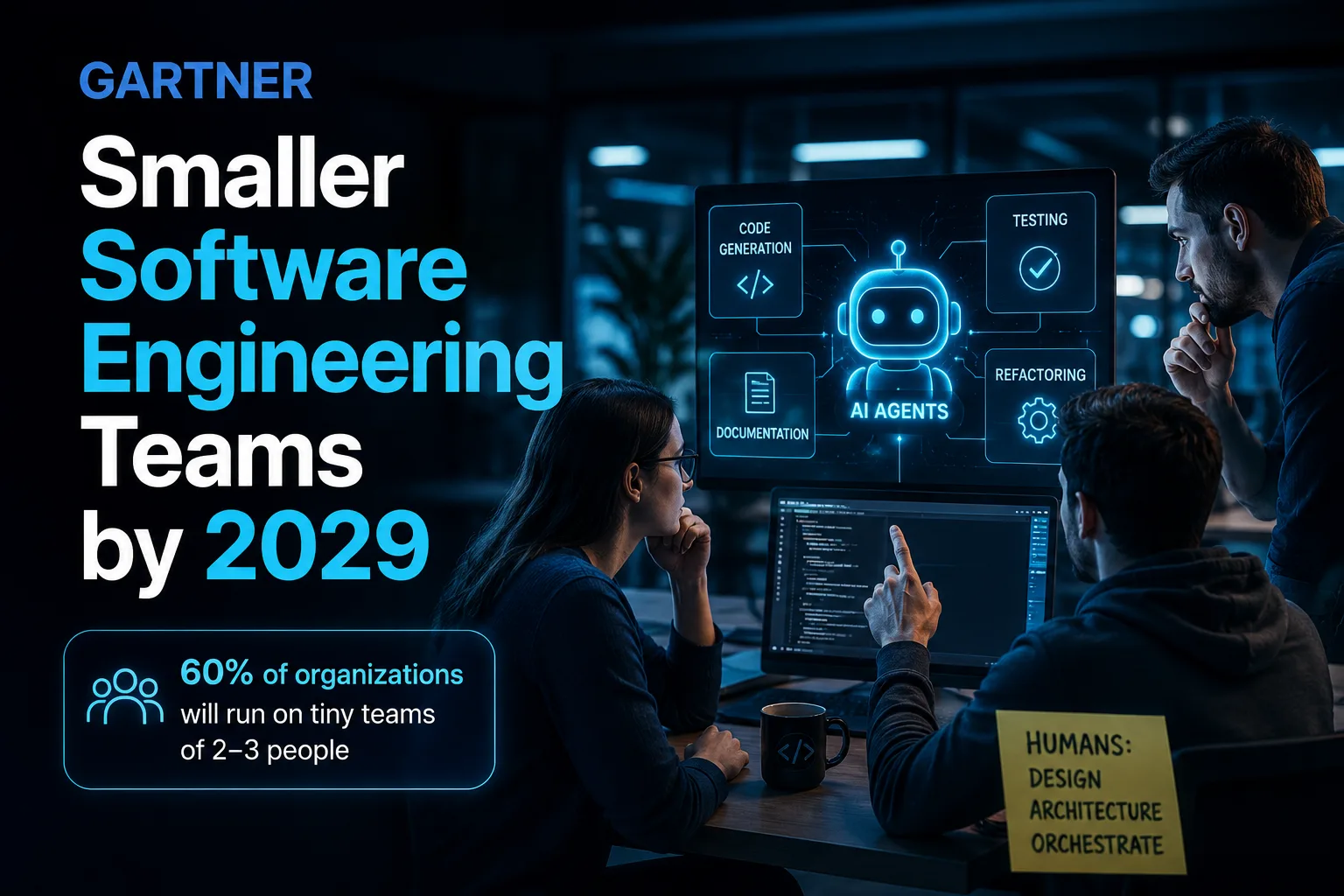
Gartner’s latest forecast states that by 2029, 60% of organizations will transition to smaller software engineering teams of just 2-3 people, relying heavily on automated AI agents to handle routine coding tasks. For working developers, this means the primary engineering bottleneck is moving away from writing syntax and toward orchestrating multi-agent systems and building robust platform engineering pipelines.
According to the forecast published by Gartner on July 7, 2026, this transition to “tiny teams” represents a massive jump from just 15% adoption in 2026. If you manage or work on a traditional two-pizza scrum team today, the structure of your daily work is about to change significantly.
Principal Analyst Aliyah Camacho explicitly notes that this shift is not a cost-saving tactic. Instead, it is a structural reorganization designed to maximize human-machine collaboration. As LLMs and agentic frameworks mature, they are absorbing the boilerplate, the basic refactoring, and the routine test generation. What remains for the human engineer is system design, architectural decision-making, and agent orchestration.
The Anatomy of Smaller Software Engineering Teams
Historically, a standard agile team consists of 6 to 9 members: a product owner, a scrum master, a designer, QA specialists, and several frontend and backend developers. Today, Gartner observes that early-adopting “tiny teams” have already shrunk to 4 to 5 members. By 2029, that number is expected to drop to 2 to 3.
To make a 3-person team functional, the roles must become highly versatile. The predicted structure looks like this:
1. Product Manager: Focuses on business logic, user requirements, and defining the acceptance criteria that the AI agents will ultimately be tested against.
2. UX/AX Designer: The traditional User Experience role expands into AI Experience (AX). This involves designing how end-users interact with non-deterministic AI features, handling latency states, and managing fallback UI when model inference fails.
3. Native Software Engineer: The sole human developer on the pod. This engineer does not write every line of code. Instead, they act as a technical reviewer and system architect. They configure the agentic workflows, define the data schemas, and review the pull requests generated by the automated systems.
This structure works only if the “routine technical tasks” are reliably offloaded. We are moving past the era of autocomplete tools like the original GitHub Copilot. We are entering the era of agentic coordination, where autonomous systems take a Jira ticket, search the codebase, write the implementation, and run the tests before requesting human review.
Platform Engineering as the Hidden Dependency
You cannot drop a single native software engineer into a legacy monolithic codebase, hand them an AI agent, and expect the output of an 8-person team. The unsung hero of Gartner’s forecast is Platform Engineering.
To succeed, these nimble units must be supported by robust platform engineering teams. The platform team builds the Internal Developer Portal (IDP), standardizes the automated workflows, and provides self-service developer utilities.
If your native software engineer has to manually provision AWS resources, write custom GitHub Actions for every new microservice, or debug flaky CI pipelines, the tiny team model collapses. AI agents operate best in highly constrained, standardized environments. They need predictable APIs to call, standardized testing frameworks to validate their code, and clear deployment targets.
The platform engineering team is responsible for building the “paved road.” When the infrastructure is entirely defined as code and accessible via self-service APIs, the AI agents can interact with the infrastructure directly. The native SWE simply approves the execution plan.
Under the Hood: How Agents Handle Routine Tasks
To understand how a 3-person team ships enterprise software, we need to look at the mechanics of human-machine collaboration. How exactly does an agent handle a “routine technical task”?
It relies on a pattern called Agentic RAG (Retrieval-Augmented Generation) combined with Tool Calling.
When a product manager assigns a ticket (e.g., “Add rate limiting to the user authentication endpoint”), the agent does not just start writing code blindly. It executes a deterministic loop:
- Context Retrieval: The agent uses an embeddings search to query the vector database containing your repository’s code. Unlike standard text chunking, modern agentic RAG architectures use Abstract Syntax Tree (AST) parsing to chunk code by functions and classes, ensuring the LLM retrieves complete, semantically valid logic blocks.
- Planning: The agent reads the retrieved authentication service code and formulates an execution plan.
- Tool Execution: The agent writes the code modification and uses a tool (via API) to push the commit to a sandboxed branch.
- Verification: The agent triggers the CI/CD pipeline. If the tests fail, the agent reads the standard error output, modifies its code, and tries again.
Here is a visual representation of this automated loop:
sequenceDiagram
    participant PM as Product Manager
    participant SWE as Native SWE
    participant Orchestrator as AI Agent
    participant VDB as Vector DB (Codebase)
    participant CI as Sandbox CI/CD

    PM->>Orchestrator: Assign feature ticket
    Orchestrator->>VDB: Query: "Find auth middleware"
    VDB-->>Orchestrator: Return AST-parsed code chunks
    Orchestrator->>Orchestrator: Generate code & unit tests
    Orchestrator->>CI: Push commit to feature branch
    CI-->>Orchestrator: Tests failed (Dependency Error)
    Orchestrator->>Orchestrator: Analyze logs & self-correct
    Orchestrator->>CI: Push updated commit
    CI-->>Orchestrator: Tests passed
    Orchestrator->>SWE: Open Pull Request for review
    SWE->>Orchestrator: Approve & Merge
In this architecture, the native SWE acts as a senior reviewer. They are checking for edge cases, security vulnerabilities, and architectural alignment, rather than typing out the rate-limiting logic themselves.
What This Means for Developers
The transition to tiny teams requires a fundamental shift in how you spend your day. The value of a developer is no longer measured by lines of code written, but by the ability to guide non-deterministic systems toward deterministic, reliable outputs.
Here is what you need to focus on practically:
1. Shift from Prompting to Compiling
Stop treating LLMs as chatbots and start treating them as runtime engines. Look into frameworks that facilitate the shift from prompting to compiling. You should be defining strict system prompts, JSON schemas for structured outputs, and fallback mechanisms when the agent hallucinates.
2. Standardize Your Tool Calling
If you want agents to help you, you need to give them tools they can actually use. This means writing wrapper scripts around your internal APIs so an LLM can easily execute them.
Below is an example of how a Native SWE might configure a tool schema in Python using the OpenAI API format. This specific tool allows the AI agent to search the codebase for specific functions before it attempts to write a patch:
# agent_tools.py
import json

# Define the tool schema for the AI Agent
code_search_tool = {
    "type": "function",
    "function": {
        "name": "search_codebase",
        "description": "Searches the repository's vector database for specific functions or classes to provide context before writing code.",
        "parameters": {
            "type": "object",
            "properties": {
                "query": {
                    "type": "string",
                    "description": "The semantic search query, e.g., 'user authentication middleware'"
                },
                "file_extension": {
                    "type": "string",
                    "description": "Filter by file type, e.g., '.ts' or '.py'"
                }
            },
            "required": ["query"]
        }
    }
}

# Example of how the agent decides to use the tool
def execute_agent_loop(client, user_prompt):
    response = client.chat.completions.create(
        model="gpt-4o",
        messages=[{"role": "user", "content": user_prompt}],
        tools=[code_search_tool],
        tool_choice="auto"
    )

    # The developer's job is now handling the agent's routing logic
    if response.choices[0].message.tool_calls:
        for tool_call in response.choices[0].message.tool_calls:
            if tool_call.function.name == "search_codebase":
                args = json.loads(tool_call.function.arguments)
                print(f"Agent is searching codebase for: {args['query']}")
                # Execute actual vector DB search here

    return response
3. Move Away from Static CI/CD
Traditional CI/CD pipelines are built to fail and wait for a human to fix them. You need to migrate toward agentic workflows vs traditional automation. Your pipelines should output machine-readable logs specifically formatted for an LLM to digest, allowing the agent to attempt an automatic fix before alerting the human developer.
The Junior Developer Dilemma
While the technology enabling these smaller software engineering teams is impressive, Gartner issues a critical warning: organizations must not stop hiring junior-level talent.
If automated agents handle all the routine technical tasks—the exact tasks we traditionally use to train junior developers—how do juniors ever build the context needed to become senior engineers?
I see this happening already. Companies are utilizing AI to bypass junior hiring, leaning entirely on their existing senior staff to review AI-generated code. This creates a dangerous long-term gap. If slowing junior recruitment continues, it will severely weaken the software engineering talent pipeline. In five years, hiring will be limited to a highly competitive, shrinking pool of senior roles.
To counter this, engineering leadership needs to redefine junior roles. Instead of fixing CSS bugs or writing basic unit tests, junior developers should be trained in agent orchestration, prompt engineering, and code review. They need to learn system architecture much earlier in their careers because they are essentially managing a team of digital interns from day one.
Key Takeaways
- Team Size Reduction: By 2029, 60% of organizations will transition to smaller software engineering teams of 2-3 people, down from standard 6-9 person scrum teams.
- Role Evolution: The typical pod will consist of a Product Manager, a UX/AX Designer, and a single Native Software Engineer.
- Platform Dependency: Tiny teams rely entirely on robust platform engineering to provide self-service infrastructure and standardized agent runtimes.
- The Talent Pipeline Risk: Organizations that use AI to stop hiring junior developers will face a severe shortage of senior architectural talent in the future.
FAQ
How does a single native software engineer manage an entire product?
They don’t write all the code manually. Instead, they act as a system architect and code reviewer, orchestrating AI agents to support smaller software engineering teams.
Will this shift reduce the overall number of software engineering jobs?
Gartner frames this as a structural reorganization rather than a cost-saving tactic. The demand for software is increasing. Engineers will likely shift from application-level feature development into platform engineering, MLOps, and agent orchestration roles.
What is the difference between UX and AX design?
User Experience (UX) deals with deterministic interfaces (buttons, forms, static data). AI Experience (AX) design handles non-deterministic interactions, such as natural language inputs, variable response times, and graceful degradation when an AI model hallucinates or fails to return a structured output.
What tools do I need to learn to stay relevant?
Focus on agentic frameworks (like LangChain, AutoGen, or CrewAI), vector databases (Milvus, Pinecone, Qdrant), and advanced CI/CD orchestration. Understanding how to structure abstract syntax trees for LLM context retrieval is highly valuable.
As organizations transition to smaller software engineering teams, their output capabilities are expanding. The organizations that succeed in this transition will be the ones that treat their AI agents not as external tools, but as core components of their platform infrastructure. Take a look at your current internal developer portal—if an AI agent cannot navigate your deployment pipeline today, your platform engineering team has work to do.
