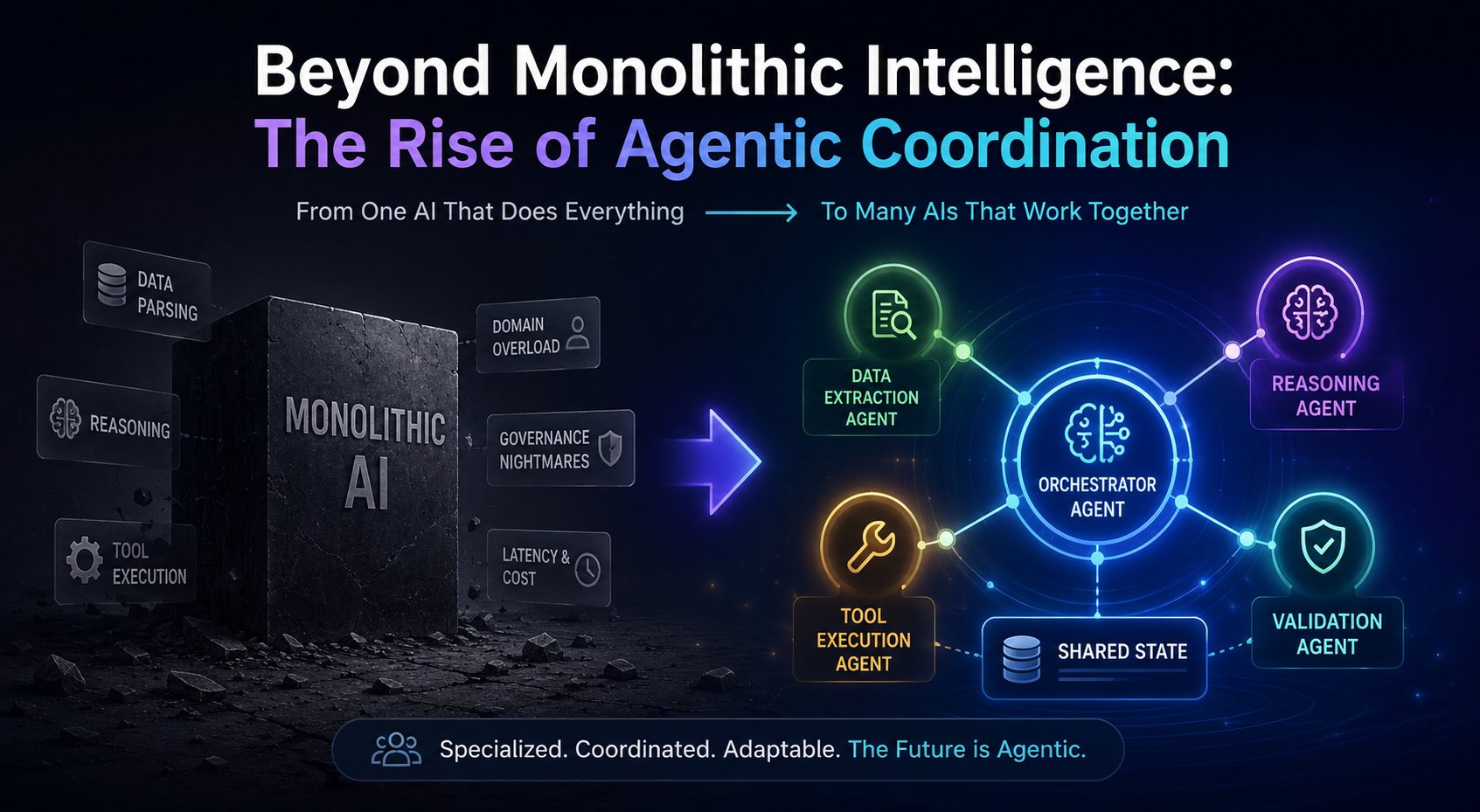
Your legacy RPA bot just hit a wall. Not because the server went down, but because a vendor sent an invoice in a slightly different PDF format—a single field moved three pixels to the left. The bot choked. The pipeline stalled. The business process died.
This is the fundamental flaw of traditional automation. You built a rigid, deterministic machine designed for a world that stays still. But the real world is messy, unstructured, and constantly shifting. If you try to solve every edge case with more if/else statements or complex regex, you aren’t scaling; you’re just building a more expensive version of technical debt.
We are seeing a massive shift. We are moving from deterministic automation—where we tell the machine exactly how to dance—to agentic AI workflows, where we tell the machine what the dance looks like and let it figure out the steps.
The Paradigm Shift: Deterministic vs. Probabilistic
Stop thinking of Agentic AI as “RPA 2.0.” It isn’t. They are functional opposites.
Robotic Process Automation (RPA) is a train on a fixed track. It is incredibly fast, highly efficient, and predictable. If the tracks are clear, it arrives exactly on time. But if there is a rock on the rails or the destination changes, the train derails. RPA excels at handling structured data and predefined workflows. It mimics repetitive, rule-based human tasks by following a script to the letter.
Agentic AI workflows, however, are like a driver in a car. The driver can see the traffic, navigate around obstacles, change routes based on context, and reach new destinations without a manual map. Agentic AI uses Large Language Models (LLMs) as a reasoning engine to interpret intent, plan sequences of actions, and use external tools autonomously.
| Feature | Traditional Automation (RPA) | Agentic AI Workflows |
|---|---|---|
| Logic Type | Deterministic (Rule-based) | Probabilistic (Reasoning-based) |
| Data Input | Structured (Tables, CSV, XML) | Unstructured (Natural language, messy PDFs) |
| Flexibility | Low (Rigid paths) | High (Adaptive planning) |
| Error Handling | Fail on deviation | Self-correct via reasoning loops |
| Complexity Scalability | Limited by predefined rules | Scales with reasoning capability |
Architecting the Difference: How They Actually Work
To understand why your current automation strategy might fail in a modern enterprise, you need to look at the underlying execution models.
In traditional automation, the flow is linear. In agentic workflows, the flow is cyclical and iterative.
graph TD
    subgraph Traditional_Automation
        A[Input: Structured Data] --> B{Rule Engine}
        B -->|Match| C[Execute Task A]
        C --> D[Execute Task B]
        D --> E[Output: Success/Fail]
    end

    subgraph Agentic_AI_Workflow
        F[Input: Unstructured Intent] --> G[LLM Reasoning Engine]
        G --> H{Plan Generation}
        H --> I[Tool Execution]
        I --> J{Observation/Feedback}
        J -->|Incomplete| G
        J -->|Complete| K[Final Output]
    end
The RPA Approach: Precision over Adaptability
RPA software bots mimic repetitive, rule-based human tasks on digital systems. They are “digital workers” optimized for high-precision, low-variance tasks.
Example: Processing structured invoice data from a standard template. If the template is Vendor_Name | Amount | Date, RPA will grab those exact coordinates every time. It is fast. It is cheap. It is brittle.
The Agentic Approach: Reasoning over Rigidity
Agentic AI leverages LLMs to interpret context and use tools. It doesn’t look for “Field A at Coordinate X.” It looks for “the total amount owed” regardless of where it sits in the document.
Example: Extracting information from a disorganized pile of email attachments, legal contracts, and handwritten notes. The agent reads the content, understands the context, decides which tool to call (e.g., a calculator or a database lookup), and verifies the result.
The Engineering Reality: Complexity vs. Cost
Here is where we need to be honest during the design review. While Agentic AI offers superior scalability in complex problem-solving, it introduces a massive new headache: unpredictability.
In RPA, “unpredictability” is rare. In Agentic AI, unpredictability is a feature of its probabilistic nature. This lack of formal verification is a massive hurdle for enterprise deployment. If you use an LLM to solve a problem that could have been solved with a simple regex or a deterministic script, you are committing Agentic Bloat. You are wasting compute, increasing latency, and introducing unnecessary risk.
The trade-offs are real:
* Latency: RPA is millisecond-fast. Agentic workflows require LLM inference cycles, which can take seconds or even minutes.
* Cost: Running a Python script to parse a CSV costs virtually nothing. Running an agentic loop through GPT-4o or Claude 3.5 Sonnet costs real money per token.
* Governance: You monitor “scripts” in RPA. In Agentic AI, you must monitor intent and outcomes. This requires entirely new observability stacks capable of tracing non-deterministic reasoning loops.
How to Implement: The Guardrail Architecture
Don’t build a “free-form” agent. That’s a recipe for disaster. The most robust production systems use a Guardrail Architecture.
This is a hybrid approach: Use Agentic AI to plan the path and handle the unstructured mess, but wrap it in RPA-like deterministic checks to validate the output before it hits your database.
Step-by-Step Implementation Logic
- Define the Intent: Capture the unstructured user request or data source.
- Reasoning Loop: Use an LLM to generate a plan and select tools.
- Tool Execution: The agent calls specific APIs, Python functions, or database queries.
- Deterministic Validation (The Guardrail): Before finalizing, pass the output through a hardcoded validation script (e.g., checking if a date format is valid or if an amount is non-negative).
- Self-Correction: If the validation fails, feed the error back to the LLM to “try again.”
Complete Working Example (Conceptual Python)
This is a simplified illustration of how you might structure a reasoning loop with a deterministic guardrail.
# Historical Example — written for illustration of Agentic logic flow

import random

class DeterministicGuardrail:
 """Validates that the agent's output meets strict business rules."""
 @staticmethod
 def validate_invoice(data):
 try:
 amount = float(data.get("amount", 0))
 if amount <= 0:
 return False, "Amount must be positive"
 return True, "Valid"
 except Exception as e:
 return False, str(e)

class AgenticWorker:
 def __init__(self):
 self.memory = []
 self.guardrail = DeterministicGuardrail()

 def reasoning_loop(self, unstructured_task):
 print(f"[*] Task received: {unstructured_task}")

 # Simulate LLM planning and tool use
 # In reality, this would be an API call to an LLM
 plan = ["extract_amount", "verify_format"]
 print(f"[*] Plan generated: {plan}")

 # Simulated extraction from unstructured data
 extracted_data = {"amount": "150.00", "vendor": "Acme Corp"}

 # The Guardrail Step
 is_valid, message = self.guardrail.validate_invoice(extracted_data)

 if is_valid:
 print("[+] Success: Data validated and stored.")
 return extracted_data
 else:
 print(f"[!] Guardrail Failure: {message}. Triggering self-correction...")
 # In a real agent, we would pass the error back to the LLM here
 return None

# Execution
worker = AgenticWorker()
result = worker.reasoning_loop("Process this messy invoice: Acme Corp billed us $150.00")
Discussion
We aren’t just changing tools; we are changing how we define “correctness.” Moving from binary pass/fail to probabilistic confidence levels is a massive cultural shift for engineering teams.
- How do we define a “success metric” for an agent that operates on probabilistic reasoning rather than binary pass/fail criteria?
- What is the optimal threshold for when an unstructured task should be handed to an Agent vs. when it should be forced into a structured RPA workflow?
- How can we implement formal verification or “unit tests” for an autonomous agent’s decision-making process without neutering its ability to adapt?