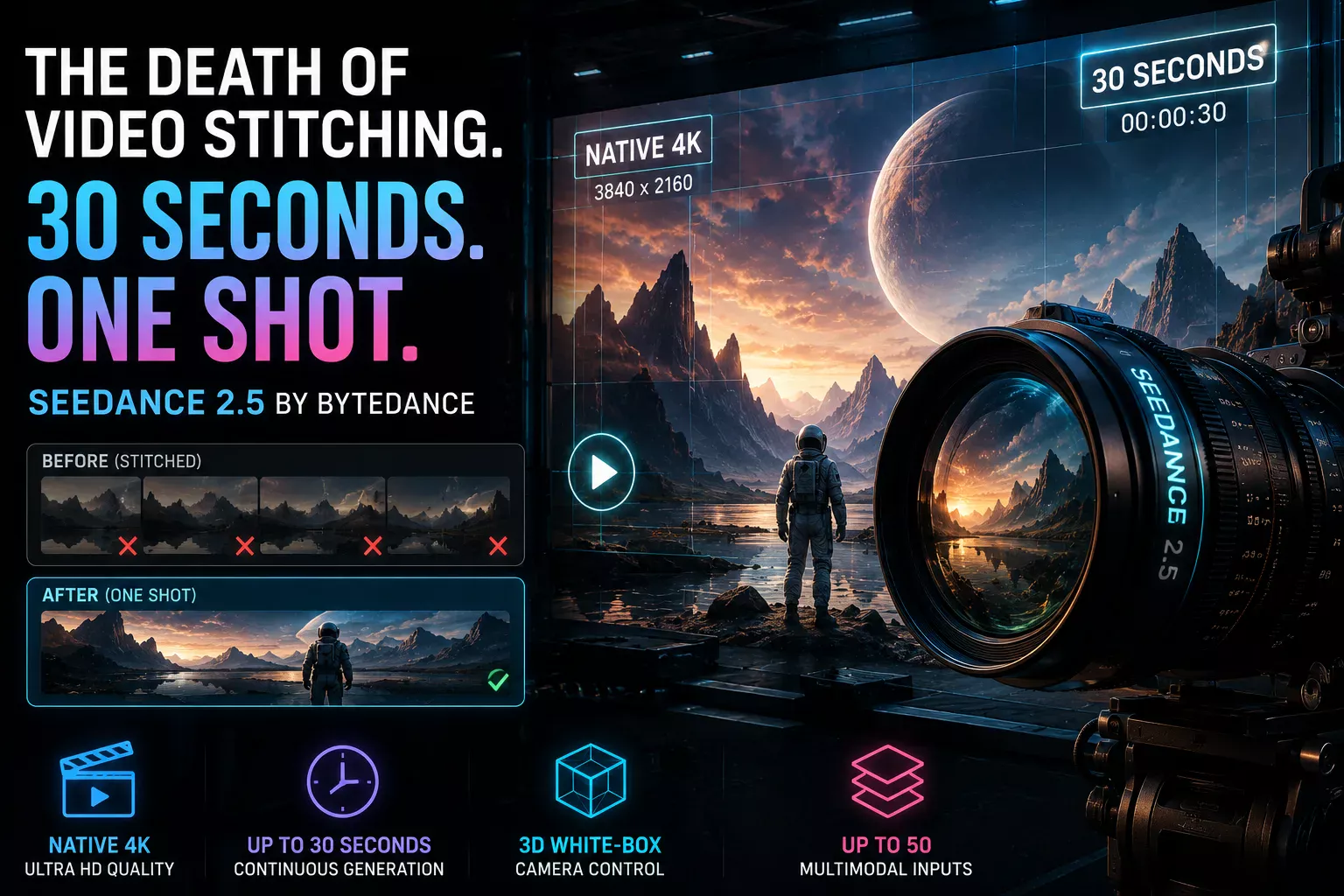
For creators and software engineers working in generative video, the industry has long harbored a frustrating secret: most high-fidelity AI videos are illusions built on fragmented pieces. Up until now, generating anything beyond a few seconds required a complex pipeline of generating short clips, interpolating frames, and stitching them together in post-processing. Each stitch introduced temporal drift, where backgrounds warped, characters morphed, and physical consistency dissolved.
ByteDance has introduced a direct countermeasure to this architectural bottleneck. At the Volcano Engine FORCE conference in Beijing, the company presented Seedance 2.5, its latest state-of-the-art AI video generation model. The defining capability of this model is its ability to generate a single, continuous, native 4K clip up to 30 seconds long in a single shot. By removing the need to stitch or extend video segments, the model addresses one of the most stubborn compute and algorithmic challenges in modern computer vision.
Along with this extended temporal window, Seedance 2.5 expands multimodal input capabilities, introduces sophisticated local video editing, and implements a 3D white-box guidance system for precise camera control. Currently in enterprise beta with a planned launch in early July, this release indicates a significant shift in how enterprise-grade video content is synthesized and controlled.
The Engineering Challenge of Long-Context Video Generation
To understand why a continuous 30-second native 4K generation is technically significant, we must analyze the computational complexity of video diffusion models.
In standard image diffusion, the model operates across spatial dimensions (height and width). Video diffusion introduces a third dimension: time. To generate a coherent sequence, the model must maintain spatial-temporal consistency across hundreds of frames.
graph TD
    subgraph Input Stage
        A[Up to 50 Multimodal References] --> E[Seedance 2.5 Core Engine]
        B[3D White-Box Camera Guidance] --> E
        C[Text Prompt & Editing Masks] --> E
    end

    subgraph Processing Pipeline
        E --> F[Spatial-Temporal Attention Blocks]
        F --> G[Continuous Latent Diffusion]
    end

    subgraph Output Generation
        G --> H[Single-Shot Native 4K Video]
        H --> I[30-Second Coherent Sequence]
    end
The Memory Bottleneck of Spatial-Temporal Attention
In a typical Transformer-based video diffusion model, attention mechanisms scale quadratically with the number of tokens. A single frame of 4K video contains approximately 8.3 million pixels. Even when compressed into a lower-dimensional latent space using a Variational Autoencoder (VAE), processing 30 seconds of video at 24 or 30 frames per second requires tracking billions of spatial-temporal token relationships.
Traditionally, developers bypassed this memory limit by utilizing sliding-window attention or generating short 3-to-4-second clips and using recursive generation (using the last frame of clip $N$ as the first frame of clip $N+1$). While computationally feasible, this approach causes “temporal decay.” As the generation progresses, the model slowly forgets the initial context, leading to visual drift where textures, lighting, and object identities degrade.
Just as edge computing shifts processing power closer to the physical device to avoid cloud latency, as detailed in our analysis of edge processing and hardware limits in autonomous systems, high-end AI video models require specialized architectural optimizations to handle massive computational loads locally and in the cloud. Seedance 2.5 overcomes this by optimizing its spatial-temporal attention blocks and utilizing the high-performance infrastructure of Volcano Engine, allowing the model to process the entire 30-second block as a unified sequence. This keeps the physical properties of the scene stable from frame 1 to frame 900.
Under the Hood: 3D White-Box Guidance and Multimodal Inputs
Generating long videos is only half the battle; directing them is the other. Traditional text-to-video models behave like black boxes, where minor prompt adjustments lead to radically different visual styles or chaotic camera movements. Seedance 2.5 addresses this by introducing two key features: 3D white-box guidance and a massive expansion of multimodal reference inputs.
Precise Spatial Control with 3D White-Box Guidance
One of the most notable technical additions in Seedance 2.5 is 3D white-box guidance. In cinematography, camera movement is defined by precise mathematical vectors: pans, tilts, zooms, and dollies. Text prompts are notoriously bad at describing these exact spatial trajectories.
3D white-box guidance allows developers and creators to feed raw 3D wireframes, bounding boxes, or camera trajectory data directly into the diffusion process. The model uses this structural data as a hard constraint, mapping the generated pixels to the specified 3D coordinates.
| Feature | Seedance 2.0 / Standard Models | Seedance 2.5 |
|---|---|---|
| Max Reference Inputs | 12 multimodal inputs | Up to 50 multimodal inputs |
| Camera Control | Text-based description (unpredictable) | 3D white-box spatial trajectory guidance |
| Max Continuous Output | Short segments (requiring stitching) | 30-second continuous single-shot |
| Resolution | Upgraded to native 4K | Native 4K (out-of-the-box) |
| Target Audience | Mainstream creator platforms | Enterprise beta & studio production |
This level of spatial and physical consistency mirrors how modern physical AI models must understand spatial constraints in industrial settings, a concept explored in depth in our study on AI-driven physical systems and logistics automation. By grounding the video generation process in a mathematical 3D space, Seedance 2.5 ensures that camera moves are physically plausible and highly controllable.
Scaling Multimodal Inputs to 50 References
Previous iterations of Seedance capped multimodal reference inputs at 12. Seedance 2.5 increases this limit to 50 multimodal reference inputs. These inputs can include:
– Character turnarounds (front, side, back views for identity preservation).
– Style references (color palettes, lighting setups, texture samples).
– Audio tracks (for synchronization and pacing).
– Depth maps and edge maps (for structural conditioning).
Processing multi-layered multimodal inputs is as complex as parsing unstructured legacy documents, which we address in our guide on document understanding and OCR challenges. By scaling to 50 reference inputs, production teams can feed an entire style guide, character bible, and storyboard sequence into a single generation run. This ensures that the synthesized 30-second clip adheres strictly to pre-established brand guidelines or narrative continuity.
Local Video Editing and the Enterprise Ecosystem
Beyond generating video from scratch, Seedance 2.5 introduces precise local video editing capabilities. In standard video editing workflows, changing an element in a video—such as replacing a character’s jacket or altering a background sign—requires tedious frame-by-frame rotoscoping and tracking.
Seedance 2.5 allows users to apply targeted text or image prompts to specific regions of a video while keeping the surrounding pixels intact. The model’s spatial-temporal attention maps isolate the target area across all 30 seconds of the video, applying the modification while preserving the lighting, shadows, and reflections cast by the modified object onto the rest of the scene.
The Volcano Engine Infrastructure Play
ByteDance’s decision to present Seedance 2.5 at the Volcano Engine FORCE conference highlights their enterprise-first distribution strategy. Volcano Engine, ByteDance’s cloud service division, provides the massive compute pipelines required to run these models at scale.
For enterprise clients, running a model that outputs 30 seconds of native 4K video is computationally expensive. By integrating Seedance 2.5 directly into Volcano Engine’s cloud infrastructure, ByteDance offers APIs that are optimized for distributed GPU clusters. This infrastructure minimizes latency and lowers the operational cost of rendering high-fidelity video.
While enterprise customers await the early July launch of the Seedance 2.5 beta, ByteDance is also upgrading its existing Seedance 2.0 model. This upgrade brings native 4K output capabilities to mainstream creator platforms, ensuring that independent creators can access high-resolution outputs even if they do not have access to the enterprise-tier 2.5 beta.
The Shifting Competitive Landscape
ByteDance’s entry into long-form, high-fidelity video generation places it in direct competition with other key players in the AI video space. Startups like Higgsfield AI (which focuses on mobile-first, highly dynamic character-driven video generation) and larger research labs are all racing to solve the core challenges of character consistency and temporal length.
While some competitors focus on consumer-friendly mobile applications, ByteDance is positioning Seedance 2.5 as a production-grade tool for film studios, advertising agencies, and game developers. The combination of 30-second continuous generation, 3D camera guidance, and 50 multimodal reference inputs targets the exact pain points of professional production pipelines, where predictability and control are more valuable than simple novelty.
Key Takeaways
- Continuous 30-Second Generation: Seedance 2.5 generates up to 30 seconds of native 4K video in a single shot, completely eliminating the visual artifacts and drift caused by stitching shorter clips.
- 3D White-Box Guidance: This feature provides precise camera control by allowing users to guide the generation using mathematical 3D trajectories and wireframes.
- Massive Multimodal Scaling: The model supports up to 50 reference inputs (up from 12 in previous versions), allowing for deep character, style, and environmental conditioning.
- Precise Local Editing: Users can modify specific regions of a video across the entire temporal sequence while maintaining accurate lighting, reflections, and spatial consistency.
- Two-Tiered Rollout: Seedance 2.5 enters enterprise beta via Volcano Engine with an early July launch, while Seedance 2.0 receives an upgrade to support native 4K output across creator platforms.
Frequently Asked Questions About Seedance 2.5
What is Seedance 2.5?
Seedance 2.5 is ByteDance’s latest state-of-the-art AI video generation model, designed for high-fidelity, long-context video synthesis and editing.
How does Seedance 2.5 eliminate video stitching?
Unlike traditional models that generate short clips and stitch them together, Seedance 2.5 processes the entire 30-second sequence as a single continuous block, maintaining temporal consistency across all frames without visual drift.
What is 3D white-box guidance?
3D white-box guidance is a control mechanism that allows users to feed 3D wireframes, bounding boxes, or camera trajectory paths into the model, ensuring highly precise and physically plausible camera movements.
How many reference inputs does Seedance 2.5 support?
Seedance 2.5 supports up to 50 multimodal reference inputs, which is a substantial increase from the 12 inputs supported by previous versions.
When will Seedance 2.5 be available?
Seedance 2.5 is currently in enterprise beta and is scheduled to launch for wider enterprise access in early July. However, ByteDance has already upgraded Seedance 2.0 to support native 4K output across various creator platforms.
The Future of Synthesized Media
As generative video models transition from research experiments into practical production tools, the emphasis has shifted from raw generation to granular control. ByteDance’s Seedance 2.5 demonstrates that the future of AI video lies not in unpredictable prompts, but in deterministic engineering controls like 3D trajectories and extensive multimodal references.
For enterprise developers and creative studios, these updates lower the barrier to producing high-end, commercial-grade video assets. By resolving the fundamental issues of temporal drift and frame stitching, Seedance 2.5 moves the industry closer to a reality where full-length, high-resolution cinematic sequences can be rendered, edited, and controlled directly from code.
Are you ready to integrate advanced generative video into your enterprise workflows? Keep an eye on the Volcano Engine portal for the early July beta release, and start preparing your multimodal asset pipelines to take full advantage of Seedance 2.5’s expanded capabilities.