
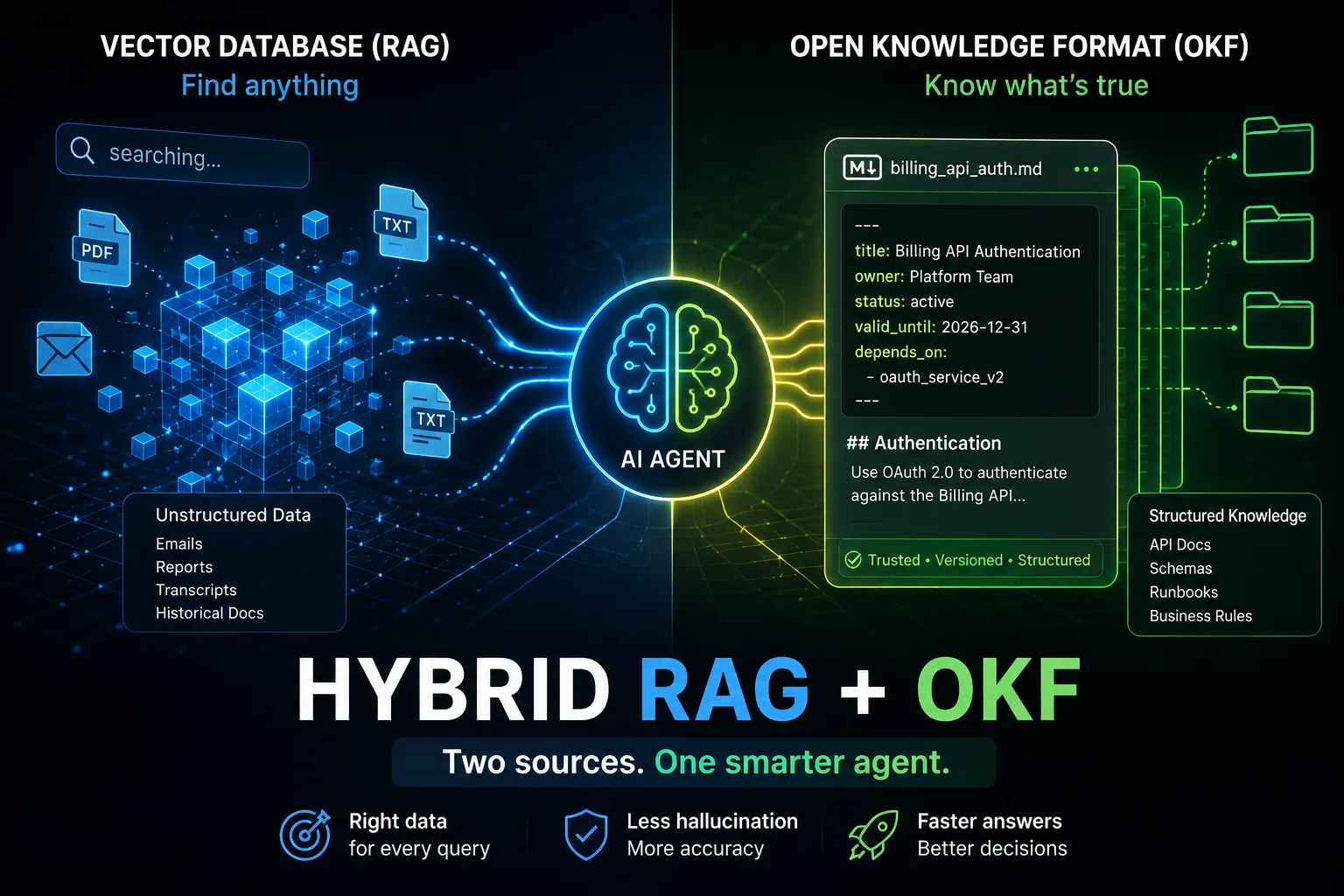
Google’s release of the Open Knowledge Format (OKF) in June 2026 gives AI agents a standardized, version-controlled way to read structured memory. For engineering teams struggling with hallucinations on rigid business logic, implementing a hybrid RAG and OKF architecture creates a system that handles both strict rules and unstructured text natively.
The Structural Limits of Pure RAG
If you have built a Retrieval-Augmented Generation (RAG) system, you know the standard playbook. You ingest documents, split them into chunks of 500 to 1,000 tokens, generate vector embeddings, and store them in a database like Pinecone, Milvus, or pgvector. When a user asks a question, the system converts the query into an embedding, runs a cosine similarity search, retrieves the top-K chunks, and passes them to a Large Language Model (LLM) to generate an answer.
This architecture is exceptionally good at discovery. If an agent needs to find a specific email thread from last year or summarize a 50-page PDF, vector search works flawlessly.
However, RAG fails predictably when dealing with structured, curated organizational knowledge.
Consider a software team’s database schema or a company’s strict compliance runbook. When you pass these documents through a text splitter, you destroy their semantic relationships. A chunk containing the columns of users_table_v2 might be separated from the chunk explaining that users_table_v2 is deprecated. Because both chunks contain the word “users,” they share a high cosine similarity with a user query. The vector database retrieves both, and the LLM confidently hallucinates an answer that blends active and deprecated architecture.
Vector databases do not inherently understand time, state, or hierarchy. They understand mathematical proximity. To solve this, developers have historically tried to patch their RAG pipelines with complex metadata filters and knowledge graphs. But the underlying issue remains: you are trying to use a search engine for tasks that require a deterministic reference manual.
Enter the Open Knowledge Format (OKF)
To solve the context-shredding problem, we need to look at how Google Cloud’s announcement of the Open Knowledge Format shifts the paradigm. OKF is not a new database, nor is it a proprietary API. It is an open specification that formalizes how to structure knowledge so that both humans and AI agents can read it deterministically.
As outlined in the official OKF specification on GitHub, OKF is heavily inspired by Andrej Karpathy’s original LLM-Wiki concept. The format is intentionally minimal: it consists of standard Markdown files paired with YAML frontmatter.
Instead of chunking a document into anonymous vectors, OKF requires you to represent discrete concepts as individual files. A database schema gets one file. A deployment runbook gets one file. The YAML frontmatter contains strict metadata—such as owner, valid_until, depends_on, and status.
Because it relies on plain text, an OKF bundle can be stored in a standard Git repository. When a business rule changes, an engineer updates the Markdown file, commits the change, and the agent instantly has the new context. There is no embedding pipeline to rerun, and no risk of stale chunks lingering in a vector index. If you are curious about the performance differences between these approaches, Structured Markdown vs Vector Embeddings for LLM Context provides a deep dive into the token economics.
Designing a Hybrid RAG and OKF Architecture
You do not need to tear down your existing vector database to use OKF. The most effective enterprise systems running today use a hybrid architecture.
In a hybrid RAG and OKF pipeline, you separate your knowledge into two distinct tiers:
1. Structured Context (OKF): High-value, high-churn, curated knowledge. This includes API documentation, database schemas, active incident runbooks, and strict compliance rules.
2. Unstructured Search (Vector DB): The long tail of historical data. This includes past incident reports, meeting transcripts, old emails, and general documentation.
To make these systems work together, you implement an Intent Router layer before the retrieval step.
graph TD
    A[User Query] --> B[Intent Router / Classifier]
    B -->|Query requires strict rules/schema| C[OKF Markdown Wiki]
    B -->|Query requires historical search| D[Vector Database]
    B -->|Complex multi-hop query| E[Parallel Retrieval]

    C --> F[Context Assembly Engine]
    D --> F
    E --> C
    E --> D

    F --> G[LLM Generation]
    G --> H[Final Output]
When a query arrives, the router evaluates whether the user is asking for a definitive fact or conducting an exploratory search. If a developer asks, “How do I authenticate against the billing API?”, the router directs the query to the OKF wiki. The system reads the billing_api_auth.md file, checks the YAML frontmatter to ensure the status is active, and passes the entire, unbroken Markdown file into the LLM’s context window.
If the user asks, “What were the main customer complaints about billing last quarter?”, the router sends the query to the vector database to retrieve semantically similar chunks from historical support tickets.
By combining these approaches, you achieve the precision of a deterministic knowledge graph with the scale of a vector search engine. We cover the broader implications of this pattern in Hybrid Memory Architectures: Fine-Tuning Meets RAG.
What This Means for Developers
Implementing OKF alongside RAG changes how you manage AI infrastructure. Here is a practical look at what this means for your day-to-day engineering workflows.
What to Try Immediately
Start small. Identify the single most hallucinated topic in your current retrieval pipeline to test the hybrid RAG and OKF approach. Usually, this is something highly structured, like an internal API spec or a pricing tier matrix. Remove those documents from your vector ingestion pipeline entirely.
Instead, write them out as OKF-compliant Markdown files. Include YAML frontmatter that explicitly defines the relationships. Build a simple Python router that checks the OKF directory for exact keyword matches on filenames or metadata tags before it ever touches your vector database.
What to Skip
Do not attempt to convert your entire unstructured document library into OKF. If you have 50,000 PDFs of historical contracts, converting them to Markdown and manually tagging them with YAML frontmatter is a massive waste of engineering resources. OKF is an investment in structure; only pay that cost where structure actually matters. Your vector database is still the correct tool for the unstructured long tail.
Managing State and Expiration
One of the most powerful features of OKF is the valid_until metadata tag. In a standard RAG pipeline, preventing an LLM from using outdated information requires complex deletion logic in your vector database. With OKF, you handle expiration at the routing layer.
Here is a simplified Python configuration showing how a developer might implement a hybrid retrieval function that respects OKF metadata:
import os
import yaml
from datetime import datetime

def retrieve_hybrid_context(query: str, okf_directory: str, vector_db_client) -> str:
    # 1. Attempt deterministic OKF retrieval first
    okf_context = []
    current_date = datetime.now().date()

    for filename in os.listdir(okf_directory):
        if filename.endswith(".md"):
            with open(os.path.join(okf_directory, filename), 'r') as file:
                content = file.read()
                # Parse YAML frontmatter (assuming standard --- delimiters)
                if content.startswith('---'):
                    parts = content.split('---', 2)
                    metadata = yaml.safe_load(parts[1])
                    body = parts[2]

                    # Check validity and relevance
                    if query.lower() in metadata.get('tags', []):
                        valid_until = metadata.get('valid_until')
                        if valid_until and datetime.strptime(valid_until, "%Y-%m-%d").date() >= current_date:
                            okf_context.append(f"Source: {filename}\n{body}")

    # If we found valid structured context, return it immediately to save latency
    if okf_context:
        return "\n\n".join(okf_context)

    # 2. Fall back to Vector RAG for unstructured long-tail data
    print("No valid OKF concepts found. Falling back to vector search.")
    vector_results = vector_db_client.similarity_search(query, k=5)
    return "\n\n".join([doc.page_content for doc in vector_results])
This approach guarantees that if an API route is deprecated and its valid_until date has passed, the agent will physically not be able to read it. The context simply does not load.
The Shift to Git-Ops for Knowledge
Adopting OKF forces a shift in how teams maintain data. Knowledge becomes code. When a product manager updates a business rule, they do not just update a Notion page; they submit a pull request to the OKF repository.
This unlocks standard CI/CD practices for AI memory. You can write GitHub Actions that lint your OKF files, ensuring every Markdown file has an owner and a valid expiration date before it is merged. If the metadata is malformed, the pipeline fails. This level of rigor is nearly impossible to enforce when dumping raw PDFs into a chunking script. For teams transitioning from basic scripts to production-grade agents, this is a critical step, as discussed in From Naive to Agentic RAG Architecture Evolution.
Operational Realities and Tradeoffs
While a hybrid RAG and OKF system solves the context shredding problem, it introduces new operational overhead.
The primary tradeoff is manual curation. A vector database is highly automated—you point a script at an S3 bucket, and it ingests everything. OKF requires discipline. Someone has to write the Markdown files, maintain the YAML frontmatter, and update the relationships when systems change. If your team lacks the discipline to maintain standard documentation, an OKF implementation will quickly rot. Rotten metadata is arguably worse than no metadata at all, because the agent will treat the outdated OKF file as absolute truth.
Furthermore, context window management becomes crucial. Because OKF loads entire Markdown files rather than 500-token chunks, you consume context windows much faster. You must rely on models with large context capabilities, like Claude 3.5 Sonnet or Gemini 1.5 Pro, to handle the assembled prompts.
Despite these tradeoffs, the reduction in hallucinations makes the architectural shift worthwhile for enterprise applications. When a generative AI system is responsible for executing actions—not just answering chat queries—deterministic context is non-negotiable. You can explore the differences in system requirements for these active systems in Comparing Agentic AI Workflows vs Traditional Automation.
Key Takeaways
- RAG destroys structure: Standard vector chunking breaks the semantic relationships required to understand database schemas, strict runbooks, and compliance rules.
- OKF provides deterministic memory: Google’s Open Knowledge Format uses standard Markdown and YAML frontmatter to create version-controlled, human-readable knowledge bundles.
- Hybrid RAG and OKF is the standard: Do not replace your vector database. Use an intent router to check OKF for strict business rules, and fall back to vector search for unstructured, historical documents.
- Knowledge as Code: OKF allows you to manage AI context using standard Git workflows, enabling CI/CD linting for metadata like
valid_untildates and ownership tags. - Zero vendor lock-in: Because OKF relies entirely on plain text files, your knowledge base remains portable across any model, cloud provider, or orchestration framework.
FAQ
Does hybrid RAG and OKF replace my vector database?
No. OKF and vector databases solve different problems. OKF is designed for curated, structured knowledge where exact relationships matter (like APIs and schemas). Vector databases excel at searching massive volumes of unstructured data (like historical emails and PDFs). A production system uses both.
How do I maintain OKF files as my organization scales?
Treat OKF files exactly like source code. Store them in a Git repository, require pull requests for updates, and use CI/CD pipelines to validate the YAML frontmatter. Assign code owners to specific domains so that documentation does not silently go stale.
What is the latency impact of checking OKF before a vector database?
The latency impact is negligible. Reading local Markdown files or querying a lightweight document index takes milliseconds, which is significantly faster than executing a dense vector similarity search. If the router finds a match in OKF, it can actually reduce overall response time by bypassing the vector database entirely.
Can I automate the creation of OKF bundles?
Yes, partially. You can write scripts to export existing structured data (like dbt models or OpenAPI specs) into OKF-compliant Markdown files. However, the business context—the “why” behind the data—usually still requires human curation to be highly effective for AI agents.
Take your most frequently hallucinated database schema or business rule today. Pull it out of your vector database, format it as a single OKF Markdown file with strict YAML frontmatter, and route your agent to read that file directly. Measure the difference in faithfulness scores yourself—the results will justify the architecture change.

Great content! Keep up the good work!