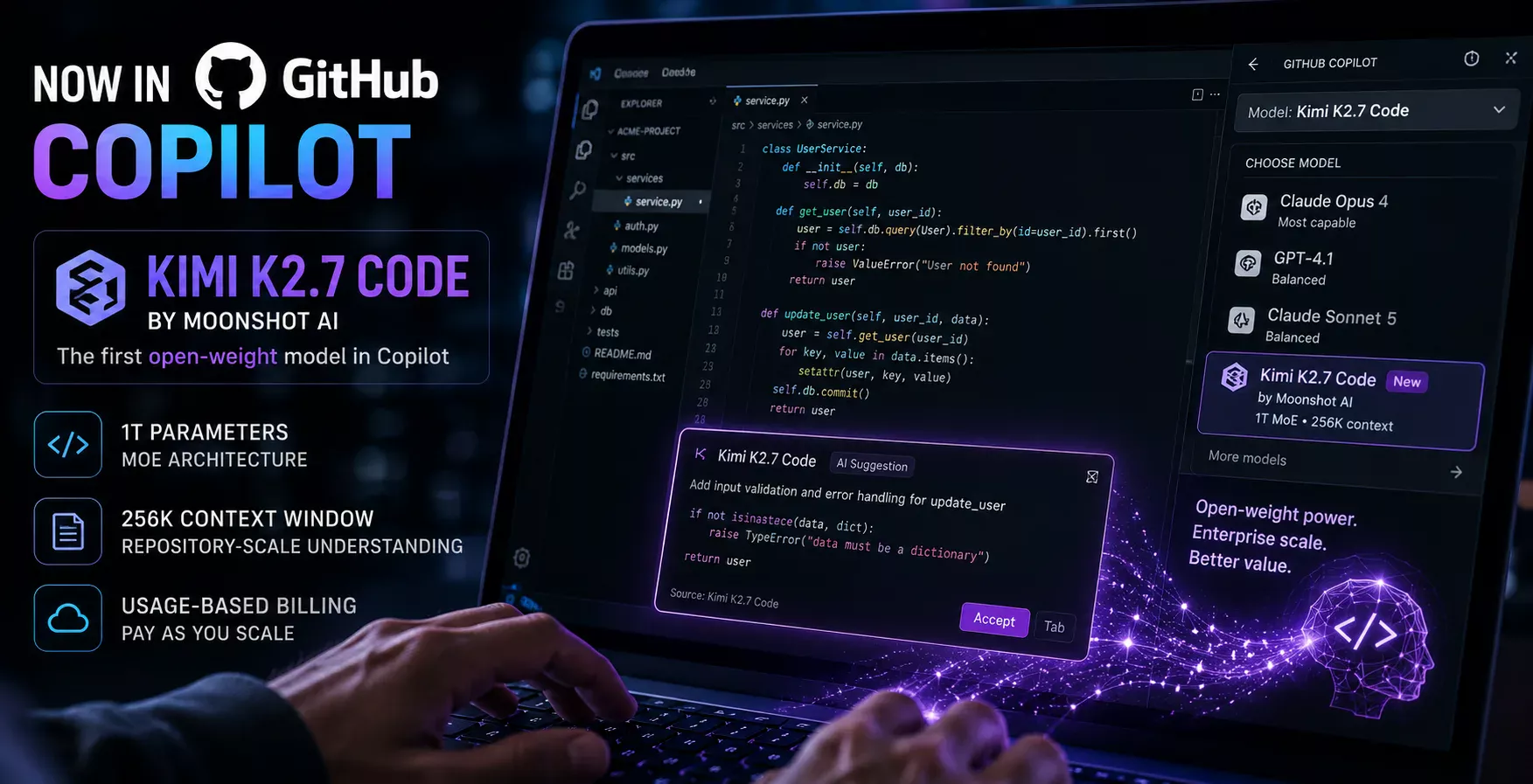
On July 1, 2026, GitHub announced the general availability of Moonshot’s Kimi K2.7 Code, marking a structural shift in the developer toolchain as the first open-weight model offered as a selectable option in the GitHub Copilot model picker. This release introduces a highly capable, open-weight alternative into an ecosystem previously dominated by closed-source, proprietary models. Engineered as a 1-trillion-parameter Mixture-of-Experts (MoE) model, Kimi K2.7 Code is optimized specifically for long-horizon coding tasks, repository exploration, and complex multi-file development.
The integration is supported by a newly introduced usage-based billing model within GitHub Copilot. Hosted on cloud infrastructure, the model is billed at provider list pricing, giving development teams a lower-cost, highly scalable alternative to standard flat-rate seats when executing heavy compute workloads. To verify this integration and its technical parameters, developers can review the official details on GitHub’s official platform announcements.
From an engineering perspective, the arrival of a 1-trillion-parameter open-weight model in the IDE represents more than just another model choice. It signals a transition toward highly specialized, sparse architectures capable of handling complete repository contexts without requiring massive, cost-prohibitive monolithic runs.
Deconstructing the 1-Trillion-Parameter MoE Architecture
To understand how Kimi K2.7 Code operates within the constraints of a real-time IDE extension, we must look at its underlying Mixture-of-Experts (MoE) architecture. While the model boasts a nominal parameter count of 1 trillion, its sparse activation mechanism ensures that only a fraction of these parameters are computed for any single token.
graph TD
    A[Input Token / Code Context] --> B[Gating Network / Router]
    B --> C{Top-K Selection}
    C -->|Expert 1: Syntax & Local Logic| D[FFN Expert 1]
    C -->|Expert 2: Multi-file Dependency| E[FFN Expert 2]
    C -->|Expert N: System Architecture| F[FFN Expert N]
    D --> G[Weighted Summation]
    E --> G
    F --> G
    G --> H[Output Token / Code Suggestion]
This routing behavior is highly beneficial for software engineering tasks. Code generation is fundamentally multi-disciplinary: a single file may require syntax parsing, database schema alignment, security compliance, and architectural pattern matching. In a monolithic model, every parameter is calculated for every token, leading to high latency and massive compute costs. In Kimi K2.7 Code’s MoE framework, a gating network dynamically routes tokens to specialized feed-forward network (FFN) “experts.”
The 256K Context Window: Repository-Scale Parsing
A key limitation of traditional coding assistants has been context window fragmentation. When working on large-scale applications, developers frequently need to analyze files across multiple directories. Standard 8K or 32K context windows force the assistant to truncate files, rely on lossy vector search embeddings, or drop critical dependency information.
With a 256K context window, Kimi K2.7 Code can ingest entire codebases, schema definitions, and dependency graphs simultaneously. This is particularly useful for:
- Upstream Impact Analysis: Determining how a change in a core database model affects controller logic across multiple microservices.
- Legacy Code Migration: Passing large legacy scripts alongside modern target frameworks to generate precise, idiomatic translations.
- Dependency Resolution: Analyzing deeply nested configuration files and package manifests to resolve version conflicts.
For teams implementing advanced context strategies, managing how this 256K window is populated is crucial. Understanding the trade-offs between different context formats can dramatically affect how well the model parses these large repositories. Developers can read more about this in our guide on Structured Markdown vs Vector Embeddings for LLM Context Optimization.
The Economics of Usage-Based Billing in GitHub Copilot
Historically, GitHub Copilot has operated on flat-rate subscription tiers. While this model is highly predictable for enterprise budgeting, it presents limitations when integrating massive, compute-heavy models like a 1-trillion-parameter MoE.
To accommodate Kimi K2.7 Code, GitHub has introduced a usage-based billing model. Under this paradigm, the model is hosted on external cloud infrastructure and billed directly at provider list pricing. This change introduces several economic advantages for engineering organizations:
| Feature | Flat-Rate Seat Model | Usage-Based Copilot Model |
|---|---|---|
| Model Selection | Limited to default proprietary models | Access to open-weight models like Kimi K2.7 Code |
| Cost Basis | Fixed monthly fee per user | Pay-per-token (input, output, and thinking tokens) |
| Compute Scaling | Standardized, low-to-medium parameter runs | On-demand scaling for massive repository-scale tasks |
| Infrastructure | Fully managed, shared tenant | Cloud-hosted with option for dedicated provider pricing |
This utility-pricing framework allows teams to use Kimi K2.7 Code selectively. Developers can run standard, single-file autocomplete tasks on faster, lightweight default models, and switch to Kimi K2.7 Code when embarking on complex multi-file refactoring or deep repository exploration.
This approach aligns with broader shifts in how enterprise teams purchase and allocate AI compute. For a deeper analysis of how computational deals and execution efficiencies are reshaping developer ecosystems, read our article on Scaling AI Agents: Why Compute Deals and Efficient Code Are the Real Story.
Mitigating the Overthinking Loop: 30% Reduction in Thinking Tokens
A common issue with reasoning-focused models is the “overthinking loop.” When faced with ambiguous code structures or complex logic, early reasoning architectures often generate excessive internal reasoning steps—consuming thousands of “thinking tokens” before producing the actual code block. This not only increases latency but also escalates token-driven development costs under usage-based billing.
Moonshot addresses this bottleneck in Kimi K2.7 Code by achieving a 30% reduction in thinking-token usage compared to its predecessor, Kimi K2.6.
[Kimi K2.6 Token Distribution]
Input Tokens  [===] 15%
Thinking Tokens [====================] 40% (Optimized Pathing)
Output Tokens [=========================] 45% (Higher Direct Code Yield)
This optimization is achieved through refined reinforcement learning from human feedback (RLHF) and targeted pruning of reasoning paths. Instead of exploring redundant syntax branches or repeating logical validations, the model’s policy network is trained to execute direct, deterministic code paths.
By curbing overthinking loops, Kimi K2.7 Code delivers faster time-to-first-token (TTFT) and reduces the operational cost of running long-context queries in the IDE. This is particularly critical when building agentic workflows where the LLM must execute iterative loops of code writing, terminal testing, and self-correction. For more on how agentic compilation is replacing basic chat-based prompting, see our discussion on Stop Prompting, Start Compiling: Why Claude Code is the Death of “Chatting”.
Engineering Multi-File Workflows and Deep Repository Exploration
Executing multi-file development requires an assistant to do more than simply read code; it must maintain a coherent mental model of the codebase’s architecture. When a developer selects Kimi K2.7 Code in GitHub Copilot, the model leverages its 256K context window to construct an in-memory representation of the workspace.
Step-by-Step Multi-File Refactoring Workflow
- Context Ingestion: The developer highlights a core API endpoint and requests a migration from synchronous database calls to asynchronous execution.
- Dependency Mapping: GitHub Copilot passes the target file, database configuration files, and related service modules into Kimi K2.7 Code’s 256K context.
- Routing and Inference: The MoE router selects specific experts specialized in async patterns and database drivers.
- Optimized Reasoning: The model processes the refactoring requirements, bypassing unnecessary thinking loops to generate a multi-file diff.
- Execution: The developer receives synchronized updates across the controller, service, and repository layers, ensuring type safety and architectural alignment.
This workflow highlights the shift from basic code generation to highly coordinated agentic execution. In these environments, the model acts as an active agent navigating a complex knowledge base. To understand how these architectures are evolving to handle deep knowledge bases, read our deep dive on From Naive to Agentic RAG Architecture Evolution.
Technical Comparison: Kimi K2.7 Code vs. Legacy Coding Assistants
To help engineering leads evaluate this integration, the table below highlights the technical differences between Kimi K2.7 Code and traditional closed-source models in Copilot:
| Technical Metric | Traditional Closed-Source Models | Moonshot Kimi K2.7 Code |
|---|---|---|
| Architecture | Dense Monolithic | Sparse Mixture-of-Experts (MoE) |
| Parameter Count | Undisclosed (typically mid-sized) | 1 Trillion (Sparse Activation) |
| Context Window | 8K to 128K | 256K |
| Distribution Model | Proprietary API Only | Open-Weight |
| Billing Type | Flat-Rate Subscription | Usage-Based (Provider List Pricing) |
| Reasoning Efficiency | Standard | Optimized (30% reduction in thinking tokens) |
Key Takeaways on Kimi K2.7 Code Integration
- First Open-Weight Option: Kimi K2.7 Code is the first open-weight model integrated directly into the GitHub Copilot model picker, providing a highly flexible alternative to closed-source options.
- 1-Trillion-Parameter MoE: The model utilizes a sparse Mixture-of-Experts architecture, routing tokens to specialized subnetworks to maintain high efficiency despite its massive parameter count.
- 256K Context Window: Built specifically for repository exploration, long-horizon tasks, and multi-file code modifications without context degradation.
- Optimized Token Economics: A 30% reduction in thinking-token usage compared to Kimi K2.6 prevents expensive overthinking loops and lowers execution costs.
- Usage-Based Billing: Hosted on cloud infrastructure and billed at provider list pricing, allowing teams to scale compute costs dynamically based on task complexity.
Frequently Asked Questions About Kimi K2.7 Code
What does “open-weight” mean in the context of GitHub Copilot?
An open-weight model means that the neural network’s trained weights are publicly accessible, allowing developers and organizations to inspect, self-host, or fine-tune the model on their own infrastructure. Its integration into GitHub Copilot means developers can access this model directly within their native IDE workflow while leveraging cloud-hosted infrastructure.
How does the usage-based billing work for Kimi K2.7 Code?
Instead of being covered solely under the standard flat-rate Copilot subscription, Kimi K2.7 Code utilizes GitHub’s newly introduced usage-based billing model. Usage is tracked based on the actual number of input, output, and thinking tokens consumed during your session, billed directly at the cloud provider’s list pricing.
What are “thinking tokens,” and why does a 30% reduction matter?
Thinking tokens are generated by reasoning models as they calculate intermediate logical steps before outputting final text or code. Because these tokens cost money under usage-based billing, reducing thinking-token usage by 30% directly lowers the cost of complex queries and minimizes latency by preventing the model from getting stuck in redundant reasoning loops.
Can Kimi K2.7 Code be used for multi-language projects?
Yes. With its 1-trillion-parameter base and extensive training on diverse codebases, Kimi K2.7 Code is highly proficient across multiple programming languages, frameworks, and configuration syntaxes, making it ideal for polyglot repositories.
How does the 256K context window benefit repository exploration?
A 256K context window allows the model to hold roughly 200,000 words or thousands of lines of code in active memory. This means you can feed entire directories, complete dependency graphs, and database schemas directly into the prompt context, enabling the model to make highly accurate, architecturally sound code suggestions across multiple files simultaneously.
The integration of Moonshot’s Kimi K2.7 Code into GitHub Copilot represents a practical step forward in how enterprise development teams allocate and utilize machine learning compute. By combining a 1-trillion-parameter MoE architecture with a 256K context window and usage-based pricing, GitHub is providing developers with the tools necessary to tackle complex, repository-scale engineering challenges without being locked into a single proprietary ecosystem.
For teams looking to optimize their development pipelines, evaluating Kimi K2.7 Code within the Copilot model picker offers a direct path to exploring the power of open-weight models in production. Navigate to your GitHub Copilot settings, explore the model picker, and configure your usage-based billing parameters to begin leveraging this advanced MoE architecture today.