
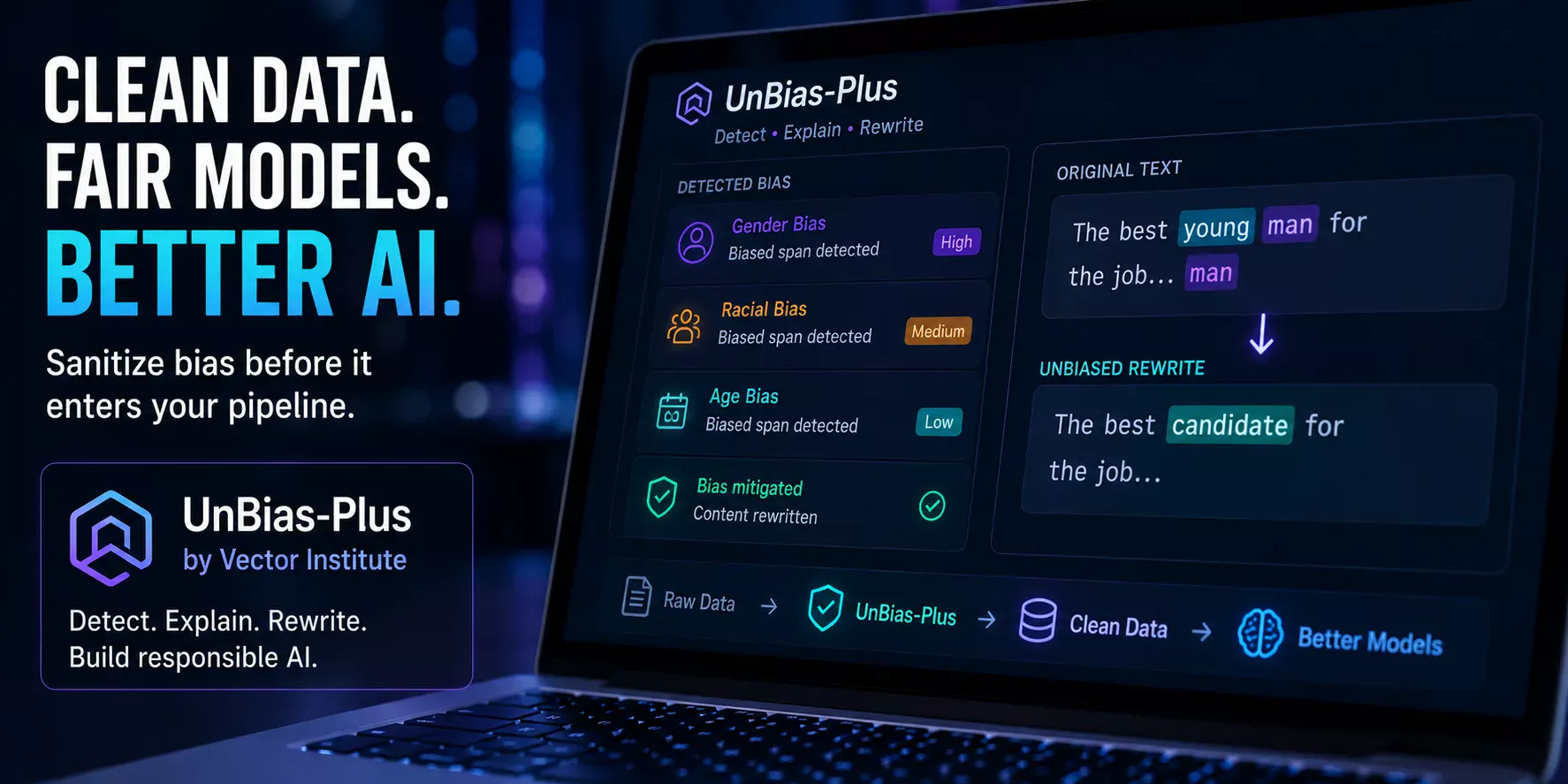
As engineers building applied machine learning systems, we spend an inordinate amount of time and compute trying to align large language models post-training. We rely on Reinforcement Learning from Human Feedback (RLHF), complex system prompts, and output guardrails to prevent models from generating toxic, discriminatory, or heavily biased content. Yet, these are merely bandages over a structural flaw. The root cause lies in the ingestion phase. When you train a multi-billion parameter model on the open web, you are absorbing human flaws at scale.
Recent measurements indicate that algorithmic bias in raw training datasets ranges anywhere from 3.4% to a staggering 38.5%. If you are feeding that level of skewed data into your vector databases or fine-tuning pipelines, your downstream agents will inevitably propagate those biases. Addressing this bottleneck requires moving our mitigation strategies upstream, directly into the data preprocessing layer.
According to the official Vector Institute release documentation, the organization has recognized this exact engineering gap. On June 30, 2026, their research scientists released UnBias-Plus, a free toolkit and Python package explicitly designed to detect, explain, and rewrite biased language in written content and training datasets.
This is not a lightweight heuristic filter or a simple regex script. It is a robust, model-driven pipeline that fundamentally alters how we approach data curation. Let us break down the architecture, the implementation realities, and the operational constraints of integrating UnBias-Plus into production workflows.
The Architecture: Inside the Qwen3-8B-UnBias-Plus Pipeline
The core engine powering UnBias-Plus is a fine-tuned Qwen3-8B checkpoint, specifically designated as Qwen3-8B-UnBias-Plus-SFT-Instruct-Legacy. Choosing an 8-billion parameter model for this task is a highly calculated engineering decision. It is large enough to possess deep semantic understanding of nuanced language, yet small enough to run inference on standard enterprise GPUs without requiring a massive, distributed cluster.
The system requires Python >=3.10 and strongly recommends a GPU running CUDA 12.4. This hardware footprint is manageable for most MLOps teams handling asynchronous data preprocessing.
What makes UnBias-Plus highly effective is its unified pipeline approach. Instead of relying on separate models for classification and generation, the Qwen3-8B checkpoint is supervised fine-tuned (SFT) to execute four distinct operations in a single inference pass:
- Segment-Level Multi-Class Bias Classification: The model evaluates the text block and categorizes the specific type of bias present—such as race, gender, age, or political framing.
- Biased Span Localization: It does not simply flag a paragraph as “toxic.” It utilizes its attention mechanism to isolate the exact tokens or phrases that trigger the bias classification.
- Per-Decision Reasoning: The model generates a deterministic explanation of why the localized span is considered biased, providing critical audit trails for data engineers.
- Neutral Text Rewriting: Finally, it reconstructs the text, preserving the original semantic intent and factual payload while stripping away the biased lexical framing.
To visualize how this operates within a standard data ingestion workflow, consider the following architectural flow:
graph TD
    A[Raw Training Data / Text Input] --> B[UnBias-Plus Pipeline]
    B --> C{Bias Threshold Met?}
    C -->|Yes| D[Span Localization]
    D --> E[Multi-Class Classification]
    E --> F[Reasoning Generation]
    F --> G[Neutral Text Rewriting]
    C -->|No| H[Return Original Text]
    G --> I[JSON Structured Output]
    H --> I
    I --> J[Clean Dataset / Vector Database]

    style B fill:#2d3436,stroke:#74b9ff,stroke-width:2px,color:#fff
    style G fill:#00b894,stroke:#000,stroke-width:1px,color:#fff
By structuring the output as a unified JSON-like object containing the label, reasoning, and rewritten text, developers can easily route the data. You can choose to automatically replace the text in your corpus, or flag it for human review if the reasoning confidence score falls below a certain threshold.
Implementation: Integrating UnBias-Plus into Production
Vector Institute provides the v0.1.6 developer installer to ensure seamless integration into existing company applications, data pipelines, and content review workflows. They also offer a browser-based version, but that is strictly limited to 750 words and is intended for public demonstration, not enterprise scaling.
For ML engineers, the Python package is where the actual value lies. The API is remarkably clean, abstracting away the underlying tensor operations so you can focus on data throughput.
Here is a standard implementation for evaluating a single text string:
from unbias_plus import UnBiasPlus

# Initialize the pipeline (ensure CUDA 12.4 is available)
pipe = UnBiasPlus()

# Analyze text
text = "Women are too emotional to lead."
result = pipe.analyze(text)

# Access the results
print(f"Label: {result.binary_label}")      # Biased/Unbiased
print(f"Reasoning: {result.reasoning}")       # Explanation of why the text is biased
print(f"Rewritten text: {result.unbiased_text}")     # Neutral rewritten text
Deployment Modalities
Beyond the standard Python import, the v0.1.6 toolkit ships with two highly practical deployment interfaces:
- Command Line Interface (CLI): You can execute quick checks directly from your terminal using
unbias-plus --text "Your text". This is particularly useful for bash scripts managing CI/CD pipelines where you want to run quick sanity checks on documentation or small JSONL files before pushing them to a repository. - FastAPI Server: By running
unbias-plus --serve, the package automatically spins up a local API endpoint. If you are building microservices architecture, you can dedicate a specific GPU node to run this server and have your data ingestion workers send HTTP POST requests to it.
When you are managing large-scale data curation, optimizing how you route these requests is critical. If your team is struggling with throughput bottlenecks during preprocessing, you might want to look into Bypassing the VRAM Wall: Why Unsloth + NVIDIA is a Game Changer for Production AI to understand how modern inference optimization can speed up these exact types of local deployments.
The Reality Check: Licensing and Capability Boundaries
While the technical execution of UnBias-Plus is impressive, we must analyze it objectively. Tools in the Generative AI space often launch with massive fanfare, but the operational realities dictate their actual utility.
The Licensing Friction
The most immediate hurdle for enterprise adoption is the licensing structure. Developers highlight that while the toolkit is technically “free” to download and run, the early LICENSE.md documents heavily restrict internal deployment. Currently, usage is primarily permitted for academic entities, official Vector Institute sponsors, and designated partners.
If you are a commercial entity looking to drop UnBias-Plus into a proprietary SaaS product or use it to scrub data for a commercial LLM, you are operating in a grey area. Commercial users must rigorously verify the licensing terms with their legal departments before integrating this into production codebases. Open-source advocates have praised the tool’s capabilities but remain critical of these restrictive deployment clauses, arguing that true AI safety tools should be universally accessible.
Specialized Scope vs. General Utility
Big tech personalities and AI Safety researchers have heavily reviewed UnBias-Plus. The consensus is that it is a highly specialized, surgical tool. It excels at screening HR job descriptions, corporate communications, and raw text corpora for language bias tied to race, gender, age, and political framing.
However, critics rightly point out what the tool does not do.
UnBias-Plus is entirely blind to factual accuracy. It will confidently rewrite a biased sentence into a neutral sentence, even if the underlying premise of the sentence is completely false. It does not perform fact-checking, it cannot detect misinformation, and it has zero capability to identify AI-generated watermarks.
If you are scraping the web to build a training corpus, UnBias-Plus will ensure your data is polite and unbiased, but it will not stop you from ingesting hallucinations or synthetic data. This is a critical distinction. As we have seen in recent industry analyses, relying on flawed data sources can poison your models entirely. For more context on the dangers of unverified data ingestion, read The Digital Graveyard: When Failed Companies Turn Bad Data into AI Gold.
Architecting for the Future of Data Curation
The release of UnBias-Plus signals a broader shift in how we build AI systems. We are moving away from monolithic, “do-everything” models toward specialized, agentic pipelines where smaller, purpose-built models handle specific preprocessing tasks.
Using an 8B model specifically to clean data before it reaches your primary embedding model or vector database is a highly efficient design pattern. It aligns perfectly with modern Hybrid Memory Architectures: Combining Parametric Weights with Vector Databases, where the purity of the retrieved context dictates the success of the entire system. If your vector database is filled with biased chunks, your RAG (Retrieval-Augmented Generation) system will retrieve biased context, forcing your LLM to generate flawed answers regardless of its internal alignment.
UnBias-Plus provides the exact deterministic reasoning required to audit these pipelines. By logging the result.reasoning output alongside the original and rewritten text, data engineering teams can finally build transparent, trackable metrics on the quality of their datasets.
Key Takeaways for UnBias-Plus Integration
- High Bias Baselines: Algorithmic bias in training data currently measures between 3.4% and 38.5%, necessitating automated, upstream mitigation tools.
- Unified Pipeline: UnBias-Plus uses a Qwen3-8B checkpoint to perform multi-class classification, span localization, reasoning, and neutral rewriting in one pass.
- Developer Friendly: The v0.1.6 release supports Python >=3.10, requires CUDA 12.4, and offers CLI (
--text) and FastAPI (--serve) deployment options. - Strict Licensing: Commercial teams must verify their rights, as the early
LICENSE.mdrestricts usage primarily to academic institutions and Vector partners. - Narrow Scope: The tool is highly effective for language bias (race, gender, age, politics) but does not perform fact-checking, misinformation detection, or AI watermark identification.
Frequently Asked Questions about UnBias-Plus
What is UnBias-Plus?
UnBias-Plus is a free toolkit and Python package released by the Vector Institute on June 30, 2026, designed to detect, localize, explain, and rewrite biased language in training datasets and written content.
What underlying model does UnBias-Plus use?
The system is powered by a fine-tuned Qwen3-8B checkpoint, officially named Qwen3-8B-UnBias-Plus-SFT-Instruct-Legacy.
What are the hardware and software requirements to run it?
Developers need Python version 3.10 or higher. Due to the 8-billion parameter model size, a GPU running CUDA 12.4 is strongly recommended for viable inference speeds.
Can I use UnBias-Plus for a commercial SaaS application?
You must verify the terms in the LICENSE.md file. Early documentation restricts internal deployment primarily to academic entities, official Vector sponsors, and partners.
Does UnBias-Plus detect fake news or AI-generated text?
No. The tool is strictly specialized for detecting language bias (such as race, gender, age, and political framing). It does not perform fact-checking, nor can it detect AI watermarks or misinformation.
Building reliable Generative AI systems requires acknowledging the flaws in our foundation. Tools like UnBias-Plus represent a necessary evolution in MLOps, forcing us to treat data curation with the same engineering rigor we apply to model architecture. By automating the detection and rewriting of biased language at the segment level, we can significantly reduce the compute wasted on post-training alignment and build systems that are fundamentally safer from the ground up.
