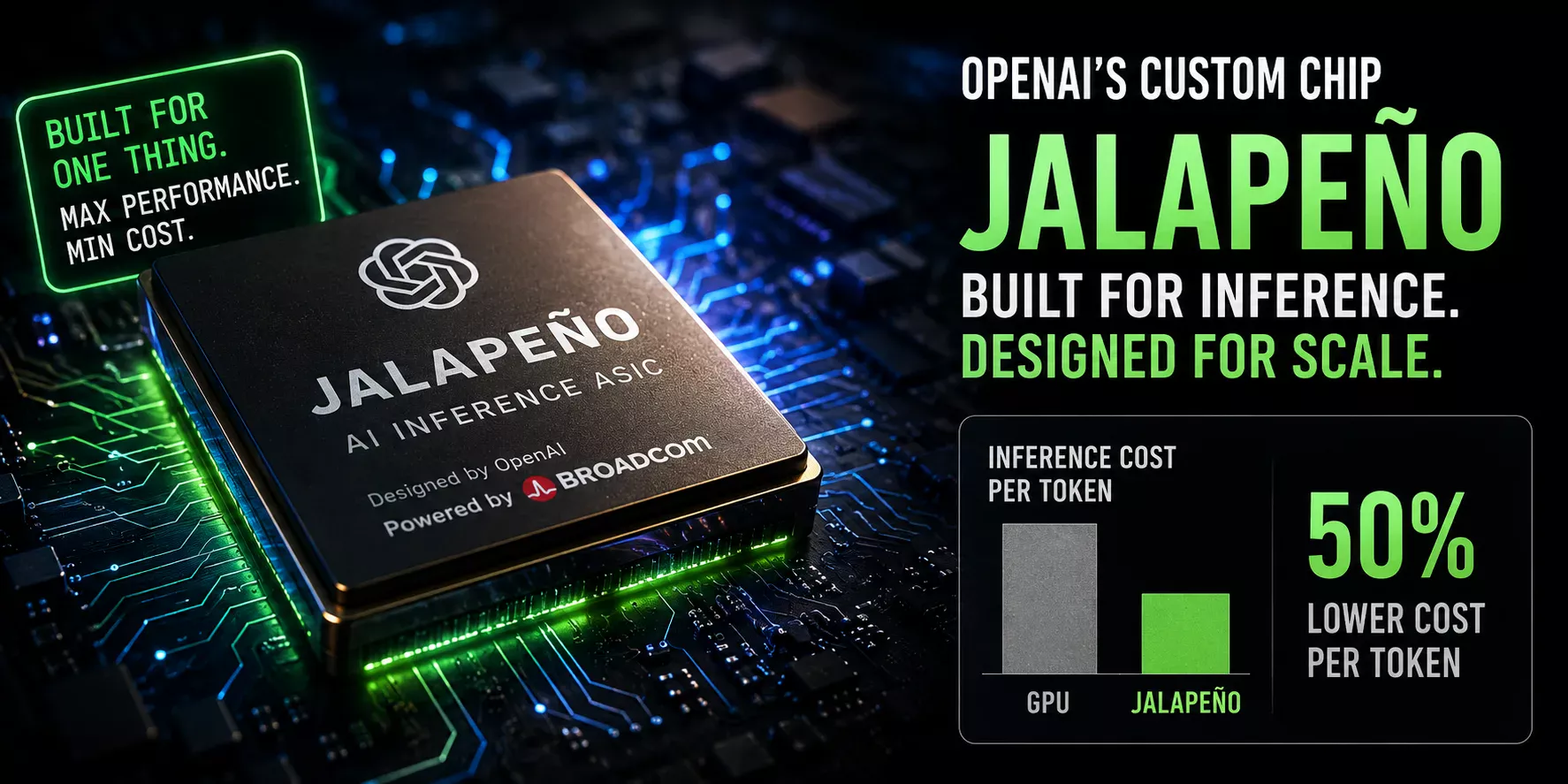
The computational overhead of Large Language Models (LLMs) has long been a primary constraint on their scalability and economic viability. While training captures the headlines, the real operational bottleneck lies in inference—the process of generating outputs from a trained model. For years, the industry has relied on general-purpose GPUs. While powerful, these chips are not natively optimized for the specific data-flow patterns of LLM inference, leading to bloated operational expenditures (OpEx) for providers.
OpenAI, in partnership with Broadcom, is addressing this inefficiency with ‘Jalapeño’, their first in-house custom application-specific integrated circuit (ASIC). This is not a marginal upgrade; it is a strategic pivot to optimize the cost-performance ratio of AI inference, aiming to make advanced AI capabilities more sustainable and accessible at scale.
The Hidden Cost of Token Generation
LLM operations are split into two distinct phases: training and inference. Training is a massive, one-time (or periodic) investment in compute to build the model’s weights. Inference, however, is a continuous cost. Every token generated for every user query incurs a computational price. As LLMs move from experimental chatbots to integrated enterprise infrastructure, these per-token costs scale linearly with usage, creating a significant economic ceiling.
General-purpose GPUs are designed for versatility, handling a wide array of parallel computing tasks. However, LLM inference often suffers from memory bandwidth bottlenecks and inefficient data movement between the compute cores and memory. These inefficiencies result in higher power consumption and increased latency. The shift toward specialized hardware is driven by a simple engineering requirement: the need to maximize throughput per watt and per dollar.
Engineering ‘Jalapeño’: Precision over Versatility
‘Jalapeño’ is an ASIC designed for a single purpose: executing LLM inference with maximum efficiency. By stripping away the general-purpose overhead of a GPU, OpenAI and Broadcom can optimize the hardware for the specific mathematical operations and data movement patterns inherent in transformer architectures.
Several technical details highlight the chip’s strategic importance:
- TSMC 3nm Fabrication: Utilizing Taiwan Semiconductor Manufacturing Company’s 3-nanometer process allows for higher transistor density and improved power efficiency. This puts ‘Jalapeño’ at the absolute leading edge of semiconductor manufacturing, similar to the ambitions seen in IBM’s sub-1 nanometer chip research.
- AI-Accelerated Design: The development cycle from concept to tape-out was compressed into just nine months. OpenAI utilized its own models to assist in the chip’s design, creating a recursive feedback loop where AI optimizes the very hardware it will run on.
- Bottleneck Mitigation: The architecture specifically targets the “memory wall”—the gap between processor speed and memory access. By streamlining the data path between memory and compute units, ‘Jalapeño’ reduces the latency associated with sequential token generation.
Architectural Shift: GPU vs. ASIC
GPUs excel at the massive matrix multiplications required during training. However, inference is often limited by memory bandwidth rather than raw compute power. An ASIC like ‘Jalapeño’ can integrate memory closer to the processing units and optimize the on-chip communication fabric for the specific data flows of LLMs.
graph TD
    A[User Query] --> B(LLM Inference Request)
    B --> C{Current GPU-based System}
    C --> D[Data Movement Overhead]
    C --> E[General Purpose Compute]
    D & E --> F[High Inference Cost / Token]
    F --> G(LLM Response)

    B --> H{Jalapeño ASIC System}
    H --> I[Optimized Data Flow]
    H --> J[LLM-Specific Compute]
    I & J --> K[Reduced Inference Cost / Token]
    K --> G
The Bottom Line: Halving the Cost per Token
Initial metrics indicate that ‘Jalapeño’ reduces the inference cost per token by approximately 50% compared to current state-of-the-art Nvidia GPUs. In a high-volume environment, a 50% reduction in OpEx is transformative. This efficiency allows for several strategic advantages:
- Competitive Pricing: Lower infrastructure costs enable more aggressive pricing for API users, lowering the barrier to entry for developers.
- Increased Model Complexity: Efficiency gains allow for the deployment of larger, more capable models without a proportional increase in cost.
- Sustainability: Reduced power consumption per token mitigates the environmental impact of massive data centers.
This move toward custom silicon is a direct attempt to break the reliance on a single hardware vendor. For a deeper look at how custom hardware disrupts market monopolies, consider Sakana AI’s Fugu Ultra.
Deployment Roadmap and Scale
‘Jalapeño’ is already operational in laboratory settings, currently processing GPT-5.3 workloads. This confirms that the hardware is compatible with the next generation of frontier models.
The rollout is phased to ensure stability:
- Late 2026: Initial integration into production infrastructure, focusing on a subset of data centers to validate real-world performance.
- 2028: Full-scale deployment across OpenAI’s entire inference fleet.
This trajectory mirrors a broader industry trend where AI leaders move toward vertical integration. Much like how SiMa.ai is bringing specialized AI to the edge for drones, OpenAI is tailoring its core infrastructure to its specific software needs. This co-design approach—where the chip and the model are developed in tandem—unlocks performance gains that off-the-shelf hardware cannot match. Such precision is critical when handling high-throughput data tasks, similar to the optimizations found in Mistral OCR 4’s document understanding pipeline.
The Shift Toward Hardware Specialization
The emergence of ‘Jalapeño’ signals the end of the “one-size-fits-all” era of AI hardware. While Nvidia’s GPUs remain the gold standard for flexibility and training, the inference market is fragmenting. With Google’s TPUs and Amazon’s Inferentia already in play, OpenAI’s entry into the ASIC space accelerates the transition toward a diversified hardware ecosystem.
For the engineering community, this means the future of LLM optimization will not happen solely in PyTorch or JAX, but at the silicon level. The tight integration of hardware and software will enable models to tackle more complex reasoning tasks with lower latency and higher reliability.
Key Takeaways
- Custom ASIC: ‘Jalapeño’ is a specialized chip designed specifically for LLM inference, developed with Broadcom.
- Cutting-Edge Node: Built on TSMC’s 3nm process for maximum power efficiency and transistor density.
- Cost Reduction: Early tests show a ~50% reduction in inference cost per token compared to GPUs.
- Rapid Iteration: The chip was designed in nine months, utilizing AI to accelerate the hardware engineering process.
- Strategic Timeline: Production deployment begins in late 2026, with full-scale adoption by 2028.
FAQ
Q1: Why not just use more GPUs?
GPUs are versatile but inefficient for the specific data-movement patterns of LLM inference. An ASIC removes the unnecessary components of a GPU, reducing power consumption and cost per token.
Q2: How does the 3nm process help?
Smaller process nodes allow for more transistors in a smaller area, which reduces the distance data must travel and lowers the energy required for each operation.
Q3: Is ‘Jalapeño’ used for training models?
No. It is specifically optimized for inference. Training still requires the massive parallel flexibility provided by high-end GPUs or specialized training clusters.
Q4: When will this affect the end-user?
While the chips hit production in 2026, the results will likely manifest as lower API costs, faster response times, and more capable models available to the public.
OpenAI’s investment in ‘Jalapeño’ proves that the next frontier of AI is not just algorithmic, but physical. By controlling the silicon, OpenAI is ensuring that the economic cost of intelligence does not become the primary bottleneck to its deployment. The transition to co-designed hardware-software systems marks a critical inflection point, paving the way for a more sustainable and scalable AI future.