
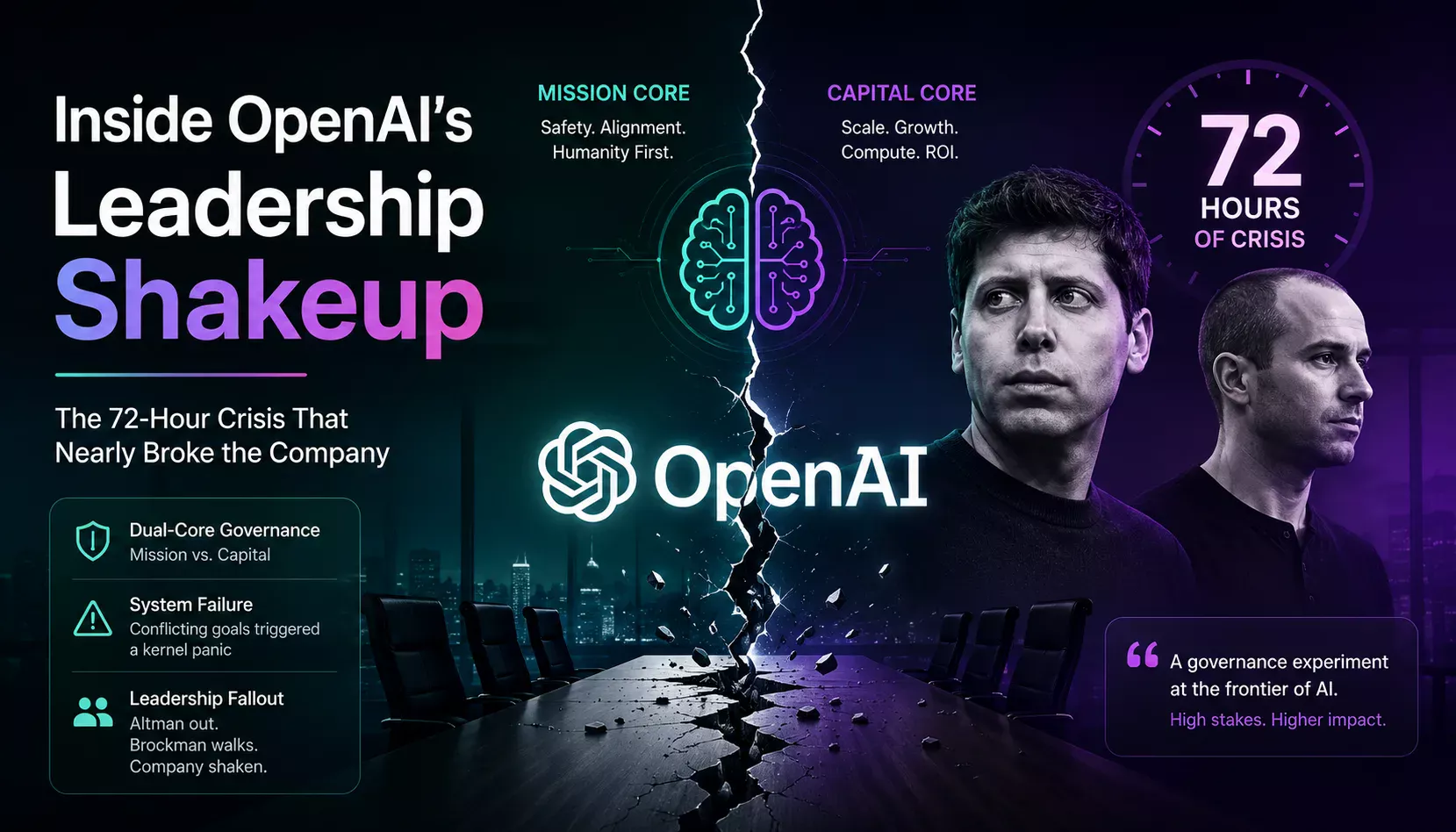
Imagine being terminated via a “quick” Google Meet call during Friday lunchtime. No preamble, no transition plan—just a sudden, jarring severance from the most influential AI company on the planet. This wasn’t a theoretical boardroom drama; this was the reality for Sam Altman in November 2023.
The fallout didn’t just hit the CEO. It triggered a domino effect that nearly dismantled the entire organization. When Altman fell, co-founder and President Greg Brockman didn’t just protest; he walked. Within hours of Altman’s dismissal, Brockman resigned. This wasn’t merely a personnel change; it was a systemic failure in succession planning that sent shockwaves through the global tech stack.
The Kernel Panic: A Dual-Core Governance Failure
Most observers view OpenAI as a research lab scaling into a product powerhouse. However, to understand the November 2023 crisis, one must look past the code and examine the governance architecture.
OpenAI operates on what I call a “Dual-Core Processor” Model. The company functions like a system with two fundamentally incompatible processors attempting to execute the same instruction set simultaneously:
- The Mission Core (Nonprofit Foundation): This core runs code designed for safety, alignment, and public good. It is structurally mandated to prioritize mission over margin.
- The Capital Core (For-Profit/Microsoft): This core runs code optimized for scale, compute efficiency, and massive ROI.
When these two cores attempt to execute conflicting instructions—such as whether to prioritize rapid deployment or rigorous safety gating—the system experiences a “kernel panic.” The 72-hour crisis was the exact moment of total system instability.
graph TD
 A[Nonprofit Foundation] -->|Controls| B(Governance & Mission)
 C[For-Profit Arm] -->|Drives| D(Scale & Revenue)
 B <-->|Structural Tension| D
 E[Board Decision: Fire Altman] -->|Triggers| F{Kernel Panic}
 F --> G[Greg Brockman Resignation]
 F --> H[Industry Volatility]
The tension is baked into the equity structure. The nonprofit Foundation holds a $130B stake in the for-profit arm, sitting just below Microsoft’s $135B stake. This creates a high-stakes tug-of-war where the margin of control is razor-thin.
The Mechanics of Structural Tension
In a standard corporation, the board’s primary fiduciary duty is to maximize shareholder value. In OpenAI’s architecture, that duty is bifurcated and often contradictory.
The Mission Core operates under a mandate to benefit humanity, which may necessitate slowing development to prevent catastrophic misuse. Conversely, the Capital Core is driven by the need to justify astronomical valuations and satisfy massive compute-intensive investments from partners like Microsoft.
When these cores attempt to execute the same instruction set—for example, “Deploy GPT-X”—the Mission Core asks, “Is it safe?” while the Capital Core asks, “How soon can we monetize it?” The November 2023 crisis was the physical manifestation of this architectural flaw, where the board’s decision to fire Altman acted as an unhandled exception that crashed the entire leadership stack.
Analyzing the Equity Stalemate
The proximity of these two stakes—$130B for the Foundation and $135B for Microsoft—creates a unique geopolitical-style standoff within a single corporate entity.
In most tech giants, the largest stakeholder holds ultimate sway. However, OpenAI’s structure suggests that the nonprofit Foundation possesses a mechanism to override the interests of even its largest commercial partner. This is a “Governance Experiment” where the rules of capitalism are being tested against the rules of mission-alignment. If the Foundation can effectively neutralize the influence of a $135B stakeholder, we are witnessing a paradigm shift in how massive-scale technology entities are governed.
The Anatomy of a Collapse: November 2023
The timeline of the collapse was an explosion rather than a slow burn.
The Friday Lunchtime Execution
The dismissal of Sam Altman via an ad-hoc video call during lunch signaled a profound lack of formal continuity protocols. When leadership changes occur in such a vacuum, it suggests that decision-making is decoupled from organizational hierarchy. This creates an immediate authority gap, leaving the technical staff—the architects of AGI—in a state of extreme uncertainty regarding mission stability.
The Brockman Domino Effect
Greg Brockman’s reaction was swift. His resignation followed Altman’s firing by mere hours, creating an immediate leadership vacuum at the highest level of technical strategy. During subsequent legal proceedings, it emerged that Brockman’s personal stake in OpenAI is worth nearly $30 billion, underscoring the immense concentration of wealth and influence involved during this period of instability.
The Stakeholder Discrepancy
The power dynamics are currently nearing parity:
| Entity | Estimated Stake Value | Primary Driver |
|---|---|---|
| Nonprofit Foundation | ~$130 Billion | Mission Alignment / Safety |
| Microsoft | ~$135 Billion | Commercial Scale / ROI |
This proximity suggests that the “Mission Core” and the “Capital Core” are locked in a structural stalemate.
Unresolved Variables: The Sutskever Factor
Significant questions remain regarding the internal drivers of the board’s decision. There is ambiguity surrounding the specific claims made by Ilya Sutskever during this period. If technical safety concerns—often championed by figures like Sutskever—were the catalyst for the “kernel panic,” it highlights the direct conflict between the Mission Core’s safety mandates and the Capital Core’s deployment goals.
The Pivot to Agentic Platforms: 2026 Strategy
Despite the chaos, OpenAI’s technical trajectory has shifted from simple chat interfaces toward Agentic Orchestration.
Reports from May 2026 indicate a significant strategic pivot. While CEO of AGI deployment Fidji Simo was on medical leave, Brockman took charge of product strategy on an interim basis. This was not merely “keeping the lights on”; it was a deliberate move to merge disparate technical silos into a unified ecosystem.
Merging ChatGPT and Codex
For years, OpenAI maintained a divide:
* ChatGPT: The consumer-facing conversational interface.
* Codex/API Teams: The developer-facing programmatic tools.
Brockman’s strategy is to collapse these boundaries to create one agent platform for enterprise users.
This represents a fundamental shift in product philosophy. Previously, OpenAI offered two distinct ways to interact with intelligence: talking to it (ChatGPT) or building with it (Codex/API). By merging these, OpenAI is attempting to create a singular “Agentic Platform” where the distinction between a conversation and a command disappears. For engineers, this means the transition from “API as a service” to “Agent as a platform,” requiring more robust guardrails and state management.
