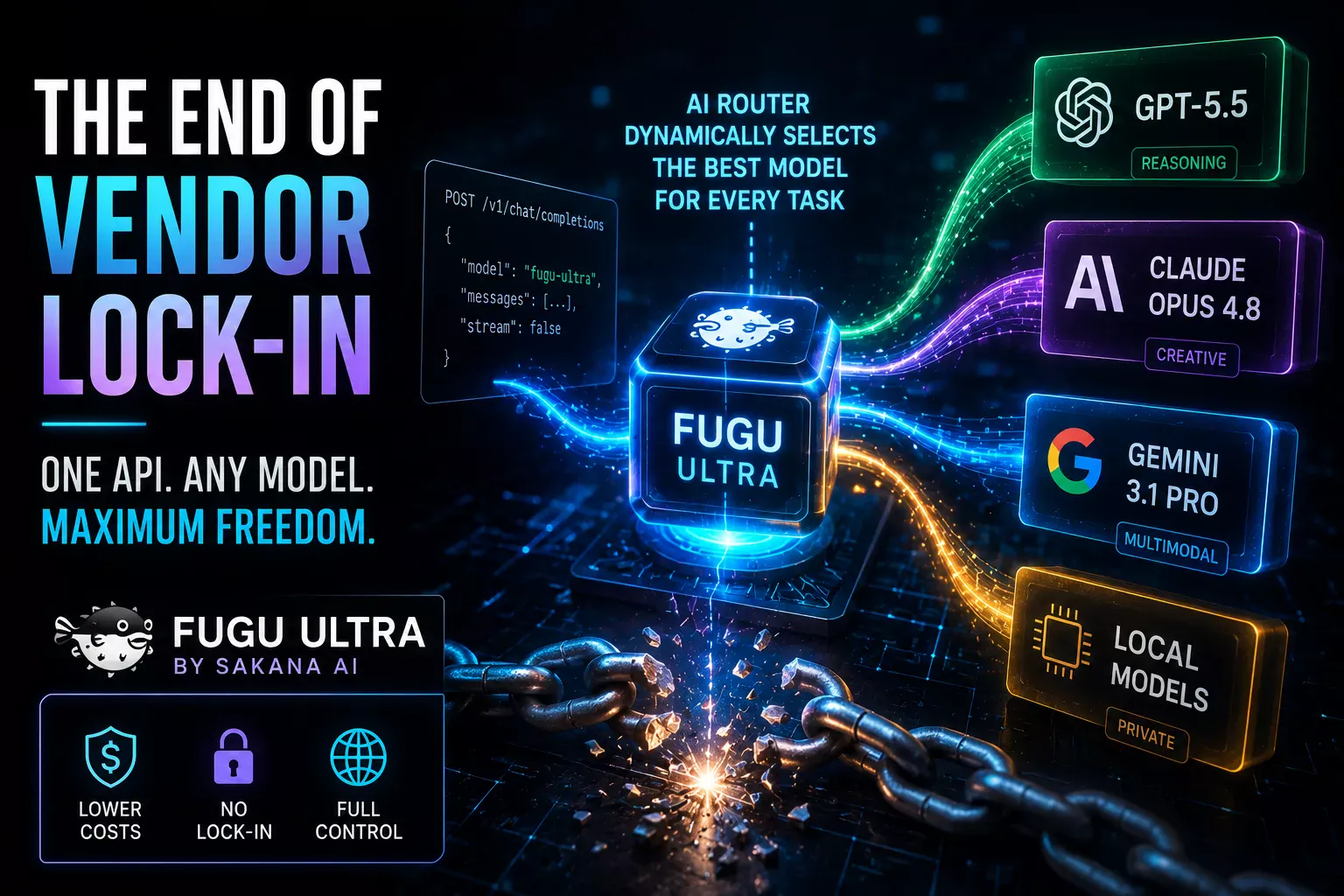
The enterprise artificial intelligence stack is facing a silent crisis of centralization. As organizations tie their core operations to proprietary API endpoints, they find themselves exposed to severe vendor lock-in, unpredictable pricing shifts, and geopolitical export controls. Tokyo-based research lab Sakana AI has introduced a structural alternative designed to break this dependency loop: Fugu and Fugu Ultra.
Presented as a single foundation model behind an OpenAI-compatible API, Fugu Ultra functions internally as an advanced multi-agent orchestration system. Instead of processing queries through a single monolithic model, it dynamically routes incoming API calls to whichever frontier model—such as GPT-5.5, Opus 4.8, or Gemini 3.1 Pro—scores highest on that specific task. This architecture mitigates the risks of relying on a single provider while bypassing the compounding costs associated with traditional multi-agent systems.
Just as edge computing is shifting workloads away from centralized servers (as explored in this analysis of edge AI solutions for autonomous drones), the software layer is transitioning toward distributed, modular execution. Fugu Ultra represents this architectural shift, decoupling the client interface from the underlying execution engine.
The Hidden Architecture of Multi-Agent Orchestration
Traditional approaches to multi-agent systems suffer from a major operational bottleneck: stacked model fees. When developers build agentic workflows using frameworks like AutoGen or CrewAI, each agent-to-agent interaction triggers sequential calls to expensive frontier models. A single user query can quickly escalate into dozens of API calls, leading to unsustainably high computing bills.
Fugu Ultra addresses this inefficiency by acting as a unified gateway. To the developer, it looks like a standard, single-model API call. Under the hood, however, it executes a highly optimized routing and coordination protocol. This approach ensures that expensive frontier models are only queried when absolutely necessary, and only for the specific sub-tasks where they excel.
graph TD
    A[Client API Call] --> B[Fugu Ultra Gateway]
    B --> C[Conductor 7B RL Model]
    C --> D[TRINITY 0.6B Coordinator]
    D -->|Assign Role| E[Thinker]
    D -->|Assign Role| F[Worker]
    D -->|Assign Role| G[Verifier]
    C -->|Dynamic Routing| H{Frontier Model Router}
    H -->|Highest Task Score| I[GPT-5.5]
    H -->|Highest Task Score| J[Opus 4.8]
    H -->|Highest Task Score| K[Gemini 3.1 Pro]
    I --> L[Response Synthesis]
    J --> L
    K --> L
    L --> B
By handling the complexity of routing at the model layer rather than the application layer, Fugu Ultra simplifies developer workflows. It dynamically balances cost, latency, and accuracy without requiring manual pipeline adjustments.
Breaking Down the Dual-Model Core: TRINITY and Conductor
The technical foundation of Fugu Ultra is detailed in two papers prepared for ICLR 2026. The system relies on a division of labor between two specialized models: TRINITY, a lightweight coordinator, and Conductor, a reinforcement learning-trained strategist.
TRINITY: The 0.6B-Parameter Role Coordinator
TRINITY is a highly optimized, 0.6-billion parameter model designed for speed and low-latency decision-making. Despite its small footprint, TRINITY is responsible for the micro-orchestration of the agentic loop. It dynamically assigns three roles to sub-components of the system:
- Thinker: Formulates hypotheses, structures reasoning paths, and decomposes complex queries into discrete steps.
- Worker: Executes code, calls external APIs, and generates draft outputs.
- Verifier: Evaluates the accuracy of the generated outputs, runs unit tests, and triggers self-correction loops if errors are detected.
By using a 0.6B model for these coordination tasks, Sakana AI avoids wasting expensive frontier model tokens on basic task management and role assignment.
Conductor: The 7B Reinforcement Learning Strategist
Operating above TRINITY is Conductor, a 7-billion parameter model trained using reinforcement learning (RL). While TRINITY manages the immediate execution of a task, Conductor discovers and refines the overarching coordination strategies.
During training, Conductor was penalized for unnecessary API calls and rewarded for task success. Through this RL feedback loop, the model learned to recognize which tasks require the deep reasoning of a model like GPT-5.5, which tasks benefit from the creative synthesis of Opus 4.8, and which can be solved using cheaper, local models. Conductor acts as the macro-scheduler, matching the task’s complexity with the most cost-effective model capable of solving it.
Handling complex inputs such as raw codebases or multi-format documents requires advanced parsing. While some engineering teams struggle with unstructured data ingestion (often solved by specialized parsing tools, such as Mistral OCR 4 for document understanding), Fugu Ultra bypasses token bloat by using Conductor to filter and route only the most relevant context to external APIs.
Benchmark Analysis: Matching Frontier Performance Without the Premium
To evaluate the efficacy of this multi-agent orchestration approach, Sakana AI tested Fugu Ultra against complex reasoning benchmarks. The results demonstrate that coordinating smaller models and routing to frontier systems can match or exceed the performance of single, massive models at a fraction of the cost.
| Benchmark | Fugu Ultra Score | Target Capability |
|---|---|---|
| SWE-Pro | 54.2 | Real-world software engineering and codebase resolution |
| GPQA-Diamond | 95.1 | Graduate-level Google-proof Q&A in science and math |
Achieving a score of 54.2 on SWE-Pro indicates that Fugu Ultra can autonomously navigate complex code repositories, identify bugs, and write functional patches. Meanwhile, its 95.1 score on GPQA-Diamond places it at or above the level of human PhD-level experts in physics, chemistry, and biology.
The key advantage of these scores is the cost efficiency. Traditional single-model reasoning architectures require massive, sustained token usage to perform Chain-of-Thought (CoT) processing. Fugu Ultra achieves these high marks by utilizing TRINITY’s local 0.6B model for the bulk of the internal reasoning steps, only calling frontier APIs when the Verifier identifies a gap that requires external validation.
Mitigating Geopolitical Friction and Export Controls
Beyond cost and performance, Fugu Ultra offers a strategic hedge against geopolitical risks. As governments introduce stricter export controls on advanced semiconductor hardware and proprietary AI models, enterprises operating globally face compliance and operational risks.
If a US-based model provider faces service disruptions, regulatory restrictions, or export bans in certain jurisdictions, software relying on that single provider could go offline. Fugu Ultra mitigates this vulnerability by maintaining a diversified backend. Because the API is OpenAI-compatible and managed dynamically by Conductor, it can route workloads across different providers and geographic regions in real-time.
In an era where technological sovereignty is as critical as cryptographic defense (similar to the security protocols detailed in this guide on quantum-resistant cryptographic data protection), having an orchestration layer that dynamically shifts workloads across global and local models is a vital hedge for international enterprises.
Key Takeaways on Fugu Ultra’s Architecture
- Dynamic Multi-Agent Routing: Fugu Ultra acts as a single API endpoint that dynamically routes tasks to the highest-performing frontier models (such as GPT-5.5, Opus 4.8, or Gemini 3.1 Pro) based on task requirements.
- Dual-Model Core: Built on two ICLR 2026 papers, the system uses TRINITY (a 0.6B-parameter model) for local role coordination (Thinker, Worker, Verifier) and Conductor (a 7B RL-trained model) for macro-routing strategies.
- High-End Benchmark Performance: Fugu Ultra scored 54.2 on SWE-Pro and 95.1 on GPQA-Diamond, matching or exceeding single-model reasoning systems.
- Cost Optimization: By handling orchestration and reasoning steps locally before calling external APIs, Fugu Ultra avoids the compounding “stacked model fees” common in traditional multi-agent systems.
- Geopolitical Risk Mitigation: Dynamic routing allows enterprises to hedge against vendor lock-in, service outages, and export-control restrictions by shifting workloads across different model providers in real-time.
Frequently Asked Questions About Fugu Ultra
How does Fugu Ultra avoid the latency associated with multi-agent systems?
Fugu Ultra minimizes latency by using the ultra-lightweight, 0.6B-parameter TRINITY model for local coordination, role assignment, and verification. External frontier models are only queried when Conductor determines that a sub-task requires specialized, high-tier reasoning, preventing unnecessary network hops.
Can Fugu Ultra run entirely on-premise?
While the orchestration core (TRINITY and Conductor) can run locally on modest hardware due to their small parameter sizes (0.6B and 7B respectively), the system is designed to route complex tasks to external frontier APIs. However, developers can configure the system to route exclusively to local, open-source models if complete data privacy is required.
What is the difference between Fugu and Fugu Ultra?
Fugu serves as the baseline API router, while Fugu Ultra incorporates the full dual-model orchestration suite (TRINITY and Conductor) along with advanced reinforcement learning strategies to handle complex, multi-step reasoning tasks like SWE-Pro software engineering problems.
How does the OpenAI-compatible API benefit developers?
Because Fugu Ultra uses an OpenAI-compatible API structure, developers can integrate it into existing codebases by changing only the base URL and API key. There is no need to rewrite application-layer agent frameworks or prompt pipelines.
How does Conductor decide which model to use?
Conductor is trained using reinforcement learning with a reward function that balances task success against API cost. It analyzes the incoming query’s complexity and context to select the most cost-effective model capable of successfully executing the task.
By decoupling the API interface from individual model providers, Sakana AI has delivered a practical solution to the industry’s growing centralization problem. Fugu Ultra demonstrates that the future of advanced AI may not lie in building ever-larger monolithic models, but in orchestrating existing models more intelligently. For enterprises looking to build resilient, cost-effective, and sovereign AI systems, this multi-agent routing approach offers a clear path forward.