For years, the industry has settled for a mediocre compromise in optical character recognition. We treated documents as simple streams of characters, ignoring the spatial intelligence inherent in a page’s layout. The result was the “plain-text dump”—a chaotic wall of text where tables collapsed into illegible strings, signatures vanished, and the critical relationship between a header and its paragraph was severed. For engineers building RAG (Retrieval-Augmented Generation) pipelines, this lack of structure was a primary point of failure, introducing noise that degraded the quality of LLM responses.
Mistral AI has shifted this paradigm with the release of Mistral OCR 4. This is not another incremental update to text recognition; it is a specialized model designed for structured document understanding. By treating the page as a geometric entity rather than a linear string, Mistral OCR 4 allows developers to extract not just the words, but the intent and architecture of the document itself.
Moving Beyond the Linear Text Stream
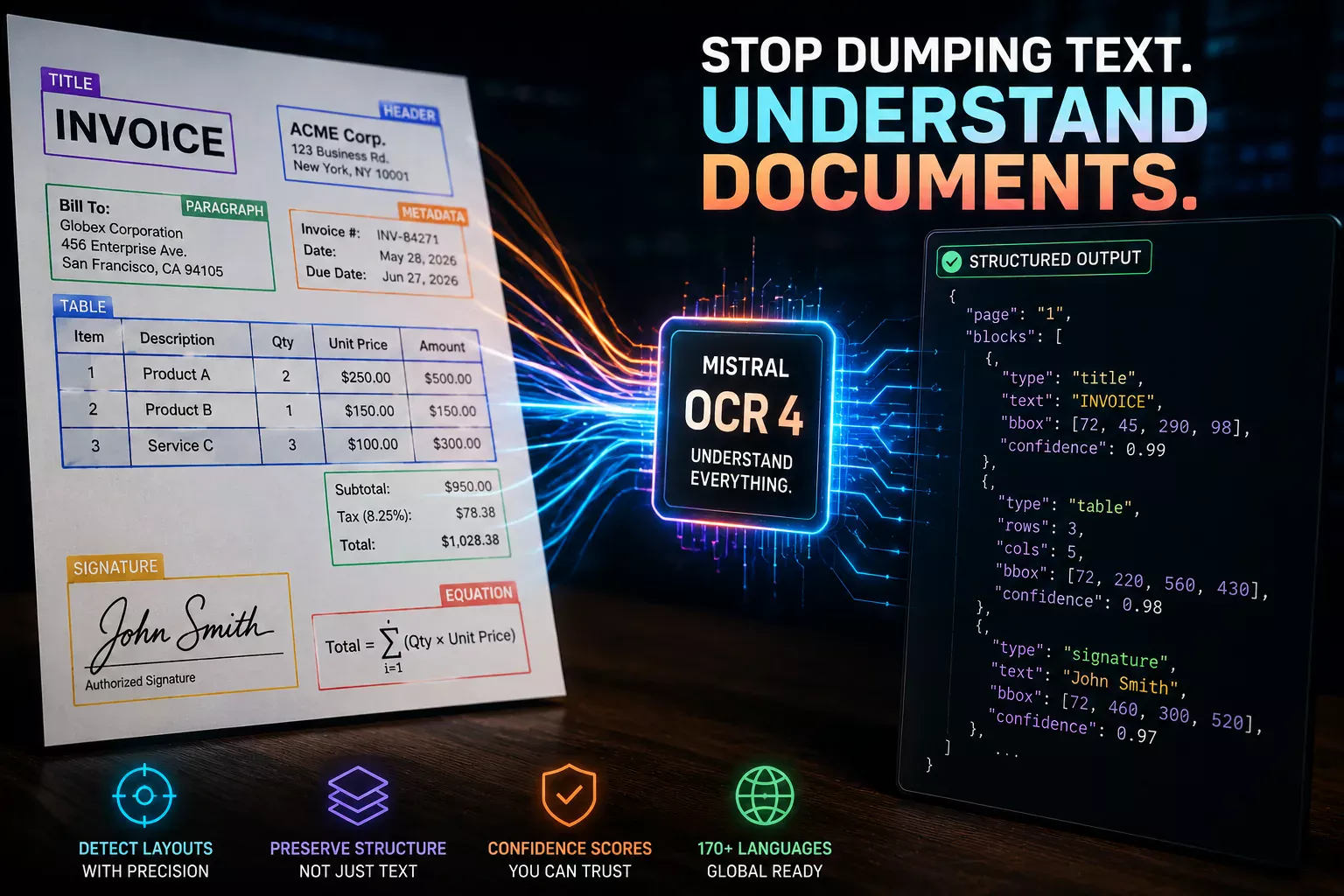
Traditional OCR focuses on the “what”—what character is this? Mistral OCR 4 focuses on the “where” and the “why.” The core technical leap here is the integration of paragraph-level bounding boxes and typed-block classifications.
When the model processes a page, it doesn’t just return a string of text. It maps the coordinates of every block of content. This means if you are processing a financial statement, the model identifies exactly where a table begins and ends, ensuring that the data remains tabular in the output. It classifies blocks into specific types, such as:
- Titles: Distinguishing headers from body text to maintain document hierarchy.
- Tables: Preserving the structural integrity of rows and columns.
- Equations: Recognizing mathematical notation that typically breaks in standard OCR.
- Signatures: Identifying the presence and location of authorization markers.
This structured approach is critical for enterprise workflows. Imagine an automated insurance claims processor that needs to verify a signature and extract data from a specific table cell. With a plain-text dump, this is an exercise in fragile regex patterns. With Mistral OCR 4, it becomes a precise coordinate-based query.
The Engineering Logic of Confidence Scores
One of the most significant pain points in production OCR is the “silent failure.” A model confidently predicts a character incorrectly, and that error propagates through the entire data pipeline. Mistral AI addresses this by implementing inline confidence scores at both the page and word levels.
From a software engineering perspective, this transforms the OCR process from a black box into a transparent pipeline. Developers can now implement automated quality gates. For example, any word with a confidence score below 80% can be flagged for human review. This creates a robust Human-in-the-Loop (HITL) workflow, ensuring that high-stakes documents—like legal contracts or medical records—are processed with near-perfect accuracy.
graph TD
    A[Input Document/PDF] --> B[Mistral OCR 4 Engine]
    B --> C{Structural Analysis}
    C --> D[Bounding Box Coordinates]
    C --> E[Block Classification]
    C --> F[Text Extraction]
    D --> G[Structured JSON Output]
    E --> G
    F --> G
    G --> H[Confidence Score Filtering]
    H --> I[High Confidence: Auto-Process]
    H --> J[Low Confidence: Human Review]
Breaking the Language Hegemony
Most high-performing OCR systems are heavily biased toward Latin scripts, leaving low-resource and rare languages to struggle with abysmal accuracy. Mistral OCR 4 breaks this trend by supporting 170 languages across 10 distinct language groups.
This isn’t just about adding more dictionaries. The model’s architecture is designed to handle the nuances of diverse scripts, demonstrating significant performance gains in areas where other systems typically fail. For global enterprises operating across multiple jurisdictions, this eliminates the need to maintain a fragmented stack of different OCR providers for different regions. A single API call can now handle a document in English, Arabic, Vietnamese, or a rare dialect with consistent structural integrity.
Quantifying Performance: The OlmOCRBench Standard
In the AI world, marketing claims are common, but benchmarks provide the ground truth. Mistral OCR 4 has been put to the test on OlmOCRBench, a public benchmark designed to evaluate the actual utility of document AI.
The model achieved a top overall score of 85.20, placing it at the peak of current performance metrics. However, the most telling data comes from real-world application. In a test involving more than 600 diverse, real-world documents, independent annotators preferred the output of Mistral OCR 4 over leading OCR and document-AI systems with a win rate of 72%.
This preference isn’t just about character accuracy; it’s about the usability of the output. When a human prefers a model’s output, it usually means the layout was preserved, the tables were readable, and the structure mirrored the original document. For the engineer, this translates to less time spent cleaning data and more time building features.
Deployment Architectures and Economic Models
Mistral AI has designed the distribution of OCR 4 to fit various security and budget profiles. The model is available through three primary channels, each serving a different architectural need.
1. The API-First Approach
For rapid prototyping and scalable cloud deployments, the Mistral API provides immediate access. The pricing is structured to be competitive, starting at $4 per 1,000 pages. For high-volume asynchronous processing, the Batch API offers a 50% discount, bringing the cost down to $2 per 1,000 pages. This makes it viable for digitizing massive archives without breaking the budget.
2. Managed Ecosystems
Integration into Mistral AI Studio and Amazon SageMaker allows teams to leverage existing cloud infrastructure. By deploying via SageMaker, enterprises can keep their data within their existing AWS VPC, reducing latency and simplifying compliance with data residency laws.
3. The Secure Enterprise Container
For organizations in highly regulated sectors—such as defense, healthcare, or central banking—cloud APIs are often a non-starter. Mistral OCR 4 can be deployed in a single container for secure, self-hosted environments. This “air-gapped” capability ensures that sensitive documents never leave the organization’s internal network while still providing state-of-the-art extraction capabilities.
| Deployment Option | Ideal For | Cost Structure | Security Level |
|---|---|---|---|
| Mistral API | Startups / Rapid Prototyping | Pay-as-you-go | Standard Cloud |
| Batch API | Large Scale Archiving | Discounted Bulk | Standard Cloud |
| Amazon SageMaker | AWS-centric Enterprises | Infrastructure + Model | VPC Isolated |
| Self-Hosted Container | Regulated Industries | License / Infrastructure | Air-Gapped |
The Impact on the RAG Pipeline
To understand why Mistral OCR 4 matters, one must look at the current state of Retrieval-Augmented Generation. Most RAG systems fail not because the LLM is weak, but because the retrieval step is flawed. If the OCR process turns a table into a jumbled list of numbers, the embedding model cannot capture the relationship between the data points.
By providing structured bounding boxes and typed blocks, Mistral OCR 4 enables “Layout-Aware RAG.” Instead of chunking text by character count, developers can chunk by document structure. You can now tell your system: “Retrieve the specific table located in the ‘Financials’ section of the document.” This precision drastically reduces hallucinations and increases the reliability of AI-driven insights.
Key Takeaways
- Beyond Plain Text: Mistral OCR 4 moves from simple text extraction to structured document understanding using bounding boxes and block classification.
- Structural Intelligence: The model identifies titles, tables, equations, and signatures, preserving the document’s original intent.
- Global Reach: Support for 170 languages across 10 groups, with a specific focus on improving accuracy for low-resource languages.
- Proven Performance: Top score of 85.20 on OlmOCRBench and a 72% win rate in human preference tests across 600+ documents.
- Flexible Deployment: Available via API ($4/1k pages), Amazon SageMaker, or as a self-hosted container for maximum security.
- Developer-Centric: Inline confidence scores at word and page levels enable the creation of high-accuracy HITL workflows.
FAQ
1. How does Mistral OCR 4 differ from traditional OCR tools?
Traditional OCR typically produces a linear stream of text (a plain-text dump). Mistral OCR 4 provides structured output, including the exact coordinates (bounding boxes) of text blocks and classifies them as titles, tables, or equations.
2. What is the cost of using Mistral OCR 4?
It is available via API starting at $4 per 1,000 pages. Users can reduce this cost to $2 per 1,000 pages by utilizing the Batch API for non-instant processing.
3. Can I run Mistral OCR 4 on my own servers?
Yes. Mistral AI provides a single-container deployment option specifically for secure, self-hosted enterprise environments where data cannot leave the internal network.
4. How does the model handle rare languages?
OCR 4 supports 170 languages across 10 groups and has been specifically optimized to perform better on low-resource languages where traditional OCR systems usually struggle.
5. What is OlmOCRBench and why does the score matter?
OlmOCRBench is a public benchmark for document AI. Mistral OCR 4’s score of 85.20 indicates it is currently one of the most accurate models for understanding and extracting structured data from documents.
For developers and architects, the release of Mistral OCR 4 represents a shift toward a more mature era of Document AI. We are moving away from the struggle of parsing messy text and toward a world where documents are treated as structured data sources. Whether you are optimizing a RAG pipeline or automating enterprise compliance, the ability to maintain structural integrity is the key to scaling AI reliably.
Ready to stop fighting with plain-text dumps? Explore the Mistral AI Studio or integrate the OCR 4 API into your workflow today to experience structured document understanding at scale.
External Sources for Further Reading:
– Official Mistral AI Announcements: mistral.ai
– Technical Analysis of Document AI: marktechpost.com
– Cloud Deployment Guides: Amazon SageMaker Documentation