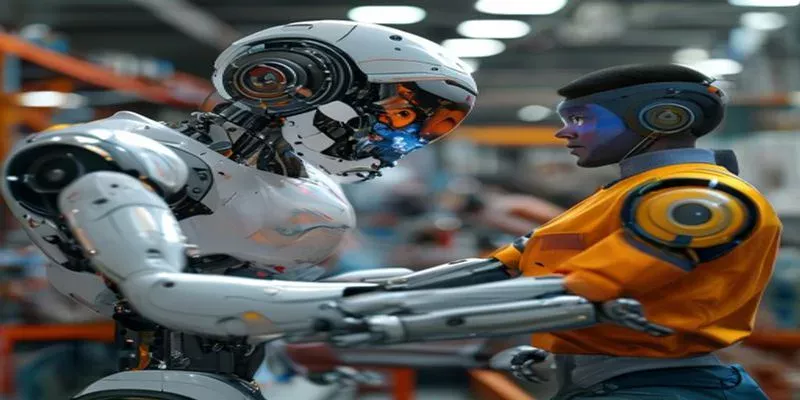
Industrial and retail automation has long been defined by physical boundaries. Heavy-duty robotic arms, while highly efficient, have traditionally been confined to safety cages and light-curtained cells to prevent catastrophic human-robot collisions. This spatial segregation limits operational flexibility and footprint efficiency. Mantis Robotics is challenging this paradigm with the MR-X, a high-performance biomimetic dual-arm robot designed to operate safely alongside human workers without physical fences.
By combining high-speed capabilities with a novel safety architecture, the MR-X addresses the core limitation of collaborative robotics: the trade-off between speed and safety. Historically, collaborative robots have been forced to operate at sluggish speeds to remain safe. The MR-X, however, boasts payloads up to 70 lbs and operational speeds up to 10.6 m/s, matching industrial-grade performance while maintaining a fenceless footprint suitable for manufacturing, logistics, and retail environments.
The Engineering Behind the MR-X
The physical architecture of the MR-X mimics human kinematics, utilizing a dual-arm configuration that allows for coordinated, multi-axis manipulation. This biomimetic design is crucial for tasks requiring complex assembly, dual-handed lifting, or precise orientation adjustments in tight spaces. With a 70 lb payload capacity, the robot bridges the gap between lightweight collaborative arms and bulky industrial manipulators.
However, operating a high-payload, high-speed robot in an open environment requires a fundamental rethink of safety engineering. Traditional safety systems rely on external sensors—such as area scanners or overhead cameras—that trigger emergency stops when a zone is breached. These systems are prone to false positives, disrupt workflows, and require significant integration overhead. Just as proactive defense mechanisms are transforming software security, physical automation requires an intrinsic, active approach to hazard mitigation.
Mantis SafetyCore: Embedded Physical AI
At the heart of the MR-X’s fenceless capability is the patented Mantis SafetyCore platform. Rather than relying on standard external vision systems, lidar, or joint-level force-torque sensors—which can introduce latency and suffer from occlusion—the SafetyCore platform utilizes a proprietary embedded sensor suite. This suite features range-based object detection, known as ‘STAR’ (Safety Through Active Range), built directly into the robot’s structure.
graph TD
    A[Proprietary Embedded Sensor Suite] --> B[STAR Range-Based Detection]
    B --> C[Embedded Physical AI Processing]
    C --> D{Human in Path?}
    D -- Yes --> E[Autonomous Reflexive Action]
    D -- No --> F[Maintain High-Speed Operation]
    style A fill:#f9f,stroke:#333,stroke-width:2px
    style E fill:#f9f,stroke:#333,stroke-width:2px
The STAR system provides continuous, high-fidelity environmental awareness. Instead of feeding data into an external high-speed processing unit to construct and update a complex 3D spatial map—a process that introduces computational bottlenecks—SafetyCore processes inputs locally. It leverages embedded physical AI for real-time processing, translating range data directly into motor control adjustments. This architecture mirrors biological reflex pathways, bypassing high-level cognitive planning to achieve near-instantaneous response times.
When a person enters the robot’s path, the SafetyCore reflex system allows the MR-X to react autonomously and safely. Because the intelligence is embedded at the hardware level, the robot can dynamically adjust its trajectory or halt motion before a collision occurs. This level of responsiveness is difficult to achieve with traditional software stacks, which often struggle with computational scaling challenges when handling high-frequency sensor feeds.
Redefining Operational Workflows
The practical implications of fenceless, high-speed automation are far-reaching. In logistics and retail fulfillment, space is a premium commodity. Eliminating safety cages allows facilities to maximize floor space, integrating the MR-X directly into existing manual workflows. Human workers can replenish bins, conduct quality checks, or perform maintenance alongside the robot without pausing production.
This seamless integration is similar to how specialized AI toolkits streamline complex workflows in other high-tech sectors. By removing physical and operational barriers, the MR-X enables a hybrid workspace where human dexterity and robotic strength complement each other.
The Path Forward for Collaborative Automation
The MR-X represents a shift in how industrial safety is conceptualized. By moving safety from external infrastructure (cages and scanners) to embedded physical AI and proprietary range-based sensing, Mantis Robotics has demonstrated that high performance and human safety are not mutually exclusive. As industries continue to demand greater agility and space efficiency, the adoption of fenceless, reflex-driven robotics will likely become the standard for modern automation architectures.