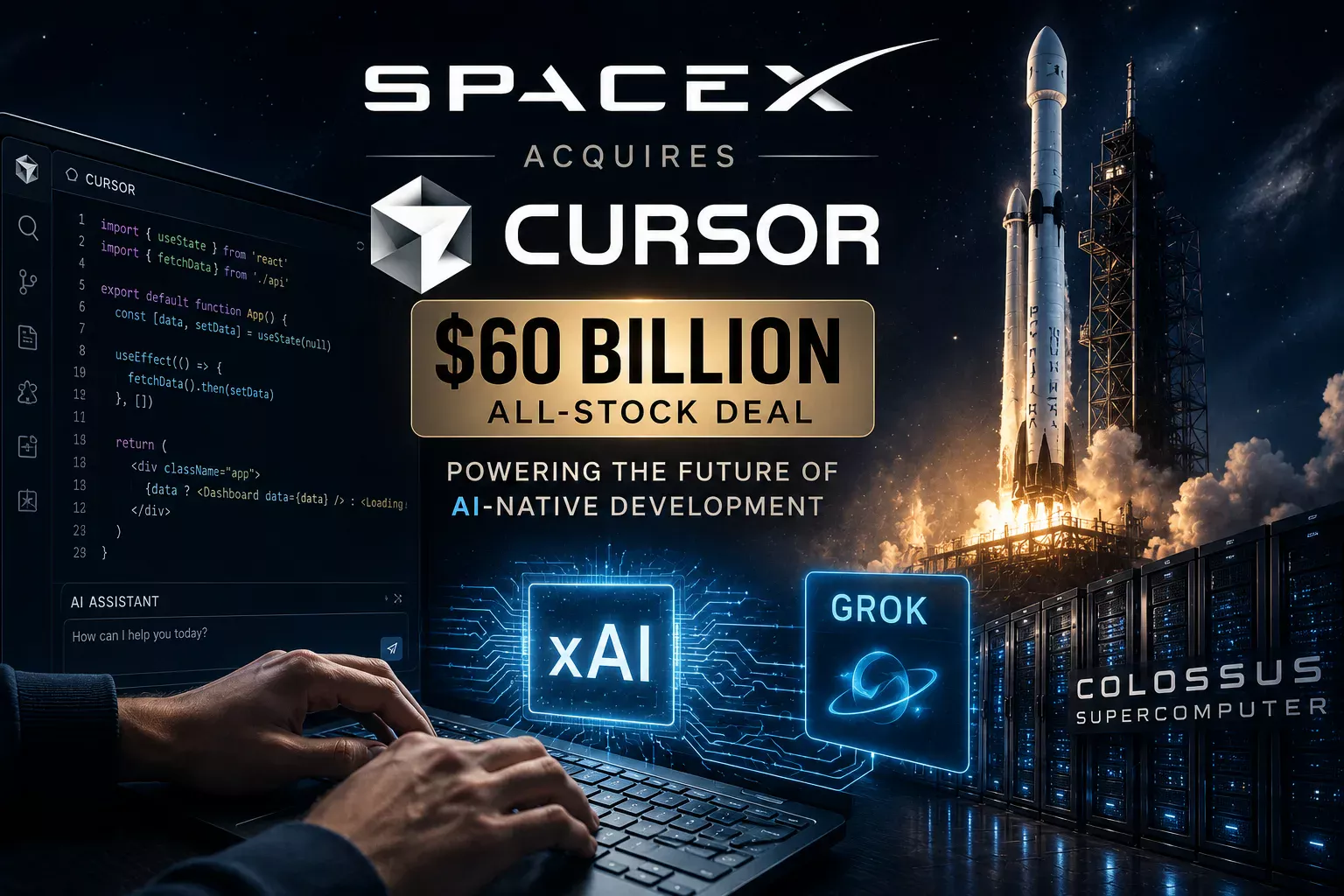
On June 16, 2026, the trajectory of generative AI and software development changed overnight. SpaceX, fresh off its monumental $75 billion IPO, announced the acquisition of Anysphere—the team behind the widely adopted AI-powered code editor, Cursor—in an all-stock transaction valued at $60 billion. This movement marks one of the largest vertical integrations in the history of the tech sector, effectively welding a mission-critical developer tool directly to the computational infrastructure of xAI.
A Strategic Pivot in the Arms Race for AI Engineering
The acquisition serves as a high-stakes play to bridge the technical gap between current developer tools and the next generation of AI-native software engineering. By absorbing Anysphere, SpaceX gains more than just a popular IDE; it secures a dominant position in the developer experience (DX) ecosystem. The objective is clear: integrate Cursor’s platform with xAI’s Colossus supercomputer and the Grok model family. This creates a closed-loop system designed to challenge incumbents like Anthropic’s Claude Code and OpenAI’s Codex.
While rivals have focused on API-level access to their models, SpaceX is betting on the interface itself. By owning the environment where code is written, compiled, and debugged, they gain unprecedented telemetry into how engineers interact with LLMs, creating a feedback loop that could accelerate model training for specialized coding tasks.
The Financial Mechanics of a $60 Billion All-Stock Deal
This transaction, set to close in the third quarter of 2026 pending regulatory approval, is structured to avoid exhausting the cash reserves generated by SpaceX’s recent Nasdaq IPO. Instead, the $60 billion price tag is funded entirely through SpaceX Class A common stock. At a post-IPO valuation exceeding $2 trillion, this acquisition represents a 3.4% dilution—a calculated trade-off for the board, signaling immense confidence in the long-term value of AI-integrated engineering workflows.
For the founders of Anysphere—Michael Truell, Aman Sanger, Sualeh Asif, and Arvid Lunnemark—the financial outcome is transformative. With Cursor having crossed $4 billion in annualized revenue as of early June 2026, the $60 billion valuation marks a significant leap from its $29.3 billion Series D valuation in November 2025. Each cofounder is estimated to see their net worth climb to approximately $2.7 billion.
graph TD
    A[SpaceX IPO] -->|Capital Injection| B(SpaceX Infrastructure)
    B --> C{xAI Division}
    C -->|Integration| D[Colossus Supercomputer]
    D -->|Model Deployment| E[Grok LLMs]
    F[Anysphere / Cursor] -->|Acquisition| G[Developer Platform]
    G -->|Unified Workflow| E
    style G fill:#f96,stroke:#333,stroke-width:2px
Developer Community Concerns: Independence vs. Integration
With 4 million active developers currently relying on Cursor, the announcement has triggered a wave of apprehension across open-source and enterprise communities. The primary anxiety centers on data privacy—specifically, how codebase context, which is currently processed to provide autocomplete and refactoring suggestions, will be handled under the ownership of a company as deeply involved in aerospace and defense as SpaceX.
Beyond privacy, users are questioning the future of product independence. Historically, when high-utility tools are acquired by massive conglomerates, the focus often shifts from developer experience to proprietary optimization. Whether Cursor remains a platform-agnostic tool or becomes a walled garden for xAI models remains a point of intense speculation.
This acquisition highlights the broader shifts in the AI sector where Google DeepMind’s recent leadership changes continue to push top talent toward specialized, high-impact environments. As US export controls continue to affect AI hardware availability, the ability to vertically integrate software and compute becomes a decisive advantage for companies like SpaceX.
Key Takeaways
- Historic Valuation: SpaceX acquired Anysphere (Cursor) for $60 billion in an all-stock deal, representing a 3.4% dilution post-IPO.
- Strategic Integration: The deal aims to combine Cursor’s developer interface with xAI’s Colossus supercomputer and Grok models.
- Financial Growth: Anysphere reached $4 billion in annualized revenue before the acquisition, doubling the net worth of its four cofounders.
- Community Impact: 4 million active developers are raising concerns regarding data privacy and the long-term independence of the Cursor IDE.
- Vertical Strategy: The move signifies a shift toward owning the full stack of AI-assisted engineering, from model architecture to the IDE.
FAQ
1. Will Cursor remain available to non-SpaceX developers?
While official plans post-closing are pending, the current strategy is focused on integrating xAI capabilities. Future product availability will depend on the final regulatory and corporate strategy.
2. How does this affect existing Cursor data privacy policies?
Users are expressing concerns regarding codebase privacy. SpaceX has not yet released specific details on how user data handling will change post-acquisition.
3. Why did SpaceX choose an all-stock deal?
Using Class A common stock allows SpaceX to acquire the startup without utilizing cash proceeds from their recent IPO, preserving liquidity for other capital-intensive aerospace projects.
4. Will Cursor still support models other than Grok?
SpaceX has signaled a focus on integrating their own AI models, which implies a potential shift toward a more xAI-centric ecosystem for Cursor users.
5. What happens to Anysphere founders?
Michael Truell, Aman Sanger, Sualeh Asif, and Arvid Lunnemark will see their net worths reach an estimated $2.7 billion each following the transaction.
As the industry watches, the success of this integration will hinge on whether SpaceX can maintain the developer velocity that made Cursor a market leader while aligning the platform with the rigorous demands of its broader engineering division. For now, the developer community remains in a state of cautious observation, awaiting the first product updates following the anticipated Q3 2026 closing date. For more analysis on how these shifts impact your development workflow, subscribe to our newsletter.