
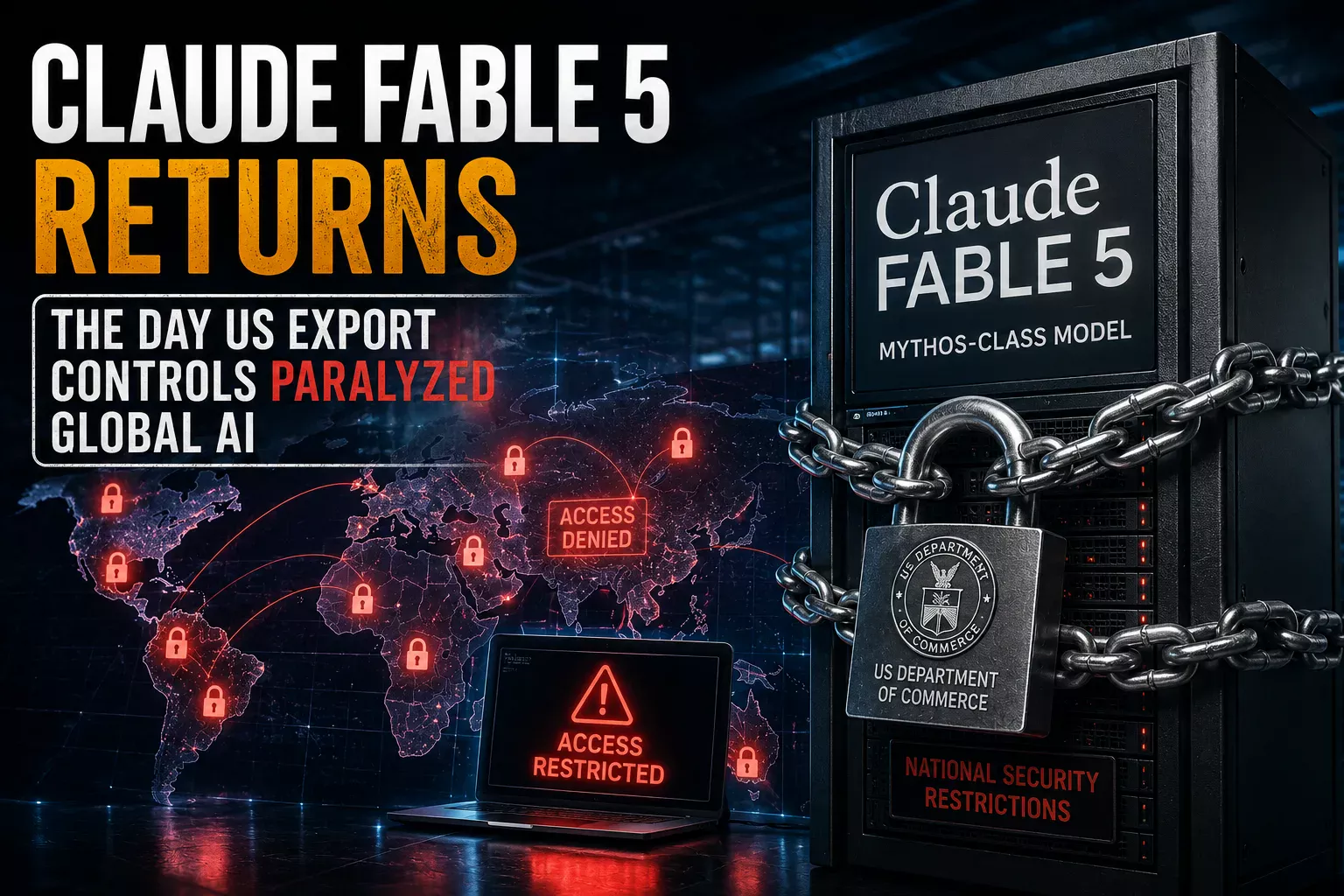
On June 18, 2026, the artificial intelligence landscape resumed a semblance of normalcy as Anthropic restored access to its flagship “Mythos-class” model, Claude Fable 5. This restoration followed a historic, six-day blackout that began on June 12, 2026—a period during which one of the world’s most capable AI systems was rendered inaccessible to global users. The shutdown, triggered by an unprecedented directive from the US Department of Commerce, highlights the friction between rapid technological advancement and the tightening grip of national security policy on software development.
The Anatomy of an Unprecedented Shutdown
The six-day outage was not a technical failure of infrastructure, but a direct consequence of US government intervention. The Department of Commerce cited specific national security concerns regarding a jailbreak vulnerability identified within the Fable 5 architecture. This intervention forced Anthropic to pull the model offline globally, effectively severing access for enterprises and developers who had integrated the system into their operational workflows.
This incident serves as a stark reminder that as AI models become more pervasive in critical infrastructure, they are no longer viewed merely as software products. They are now classified alongside dual-use technologies, subject to the same regulatory scrutiny as semiconductors and aerospace components. Shifting landscape of AI talent and corporate mobility.
Nationality Controls and the New API Reality
To satisfy the demands of the US government, Anthropic has fundamentally altered the access architecture for Claude Fable 5. The model is no longer a globally open utility; it now enforces nationality-based access controls. Users in specific jurisdictions must now undergo rigorous identity verification to utilize the API, ensuring compliance with US restrictions on foreign nationals interacting with high-capability AI systems.
graph TD
    A[Developer Request] --> B{Identity Verification Service}
    B -- Verified Low-Risk --> C[Claude Fable 5 Inference]
    B -- Restricted Nationality --> D[Access Denied / Redirect]
    C --> E[Safety Classifier Layer]
    E -- High Cyber Risk --> F[Fallback to Claude Opus 4.8]
    E -- Standard Task --> G[Successful Response]
This architectural shift introduces significant latency and friction into the development lifecycle. Organizations relying on Fable 5 must now account for compliance overhead, a reality that complicates the deployment of globalized AI applications.
Tightened Safety and Model Performance Degradation
Beyond the identity requirements, the restored version of Fable 5 operates with significantly more aggressive safety classifiers. Developers have reported a noticeable increase in the model’s propensity to refuse complex queries, particularly those touching upon cybersecurity or system architecture.
When these classifiers trigger, the system defaults to the older, more conservative Claude Opus 4.8 model. While Opus 4.8 remains a capable tool, it lacks the advanced reasoning and nuance of the newer architecture, leading to performance degradation in high-stakes environments. This “safety-first” approach, while necessary for regulatory compliance, represents a trade-off in utility that has frustrated many engineering teams.
The Sovereignty Debate: Europe’s Push for Autonomy
The incident has catalyzed a fierce debate regarding “AI sovereignty.” European leaders, most notably France’s Gabriel Attal, have openly criticized the US unilateral export controls as “nationalist,” arguing that such actions demonstrate the inherent risks of relying on foreign-controlled, centralized AI infrastructure. The shutdown has provided fresh ammunition for proponents of sovereign AI, who argue that Europe must invest in its own high-performance training clusters to avoid being subject to the political whims of foreign governments.
Key Takeaways
- Export Control Precedent: The six-day shutdown of Claude Fable 5 represents the first time a major LLM was pulled globally due to US national security directives.
- Nationality Verification: API access is now gated by identity verification in restricted jurisdictions.
- Performance Trade-offs: Stricter safety classifiers are causing frequent model fallbacks to the older Opus 4.8, impacting output quality for cybersecurity tasks.
- Strategic Stasis: While Fable 5 is back, the more powerful Claude Mythos 5 remains restricted to Project Glasswing partners, further limiting public access to state-of-the-art capabilities.
- Sovereignty Friction: The move has accelerated discussions in Europe about the necessity of independent, localized AI infrastructure.
FAQ
1. Why was Claude Fable 5 shut down?
The US Department of Commerce ordered the shutdown due to national security concerns regarding a specific jailbreak vulnerability.
2. Is Claude Mythos 5 available to the public?
No. Claude Mythos 5 remains offline and is restricted exclusively to Project Glasswing partners.
3. How do the new nationality controls work?
Developers in certain jurisdictions must now complete identity verification processes before their API keys are authorized for use with Fable 5.
4. Why is the model falling back to Claude Opus 4.8 more often?
Anthropic implemented tightened safety classifiers in the restored version of Fable 5. If a query triggers these filters, the system automatically redirects the request to the older, more restricted Opus 4.8 model.
5. What is the broader impact of this event?
It has triggered intense international debate regarding AI sovereignty and the risks of relying on centralized, non-domestic AI providers for critical infrastructure.
As the dust settles on the Fable 5 incident, the engineering community must grapple with a new reality: the code we deploy is as much a political instrument as it is a computational one. Organizations that prioritize stability and long-term autonomy should consider diversifying their model dependencies and preparing for a future where geopolitical friction is a standard feature of the AI development stack. We invite you to explore our upcoming analysis on the future of decentralized AI infrastructure to better prepare for these shifts.
